
Abstract:
From year to year, Indonesian Export Financing Institution recruits’ employees. Each new employee is to be contracted for one year, and if he performs excellently and achieves the specified target within one year, he will be appointed as permanent employee. Researchers used SEM with AMOS 24. The sample of respondents numbered 156. The change in Performance of Employee determined by Stress of Work, Motivation of Work, Competition, and Length of Work is 43% while the rest 68.1% is the contribution of other variables that have not been included in this study. Determination of stress of work, the motivation of work, competition, length of work, employee performance in a variety of significant positive and not significant, but the contribution of each in a square multiple correlation shows this research model is quite good.
Key Words:
Stress of Work, Motivation of Work, Competition, Length of work, Employee Performance.
Preliminary Background
The era of globalization has an impact on the business world. Globalization causes very tight competition. With globalization, the business world is inevitably encouraged to achieve an effective and efficient corporate organization. The effectiveness and efficiency of a company are needed so that the company can survive in the world of intense competition today. The Indonesian Export Financing Institution (LPEI) - Indonesia Eximbank (IEB), formerly known as the Indonesian Export Bank (BEI), is an institution formed by the government in order to support the implementation of national export financing activities. This institution has the authority to establish national export financing schemes, restructure public export financing, and re-insure insurance carried out in the scheme and capital participation. The Indonesian Export Financing Institution (LPEI) has its head office in Jakarta, four regional offices in Medan, Surabaya, Makassar and Surakarta, and three marketing offices in Batam, Balikpapan, and Denpasar.
From year to year, the Indonesian Export Financing Institute (LPEI) recruits. Each new employee is to be contracted for one year, and if he performs excellently and achieves the specified target within one year, he will be appointed as permanent employee. For each section - all employees are considered equal, and there are no differences. The provision of wages or salaries depends on the grade of each person. The grade does not always increase every year, but it depends on the performance of the employees themselves and the performance of the institution. Work performed follows daily routines. There have not yet been any complaints about the dense work that has survived to be promoted and reach higher grades. The key to success in Indonesia Export Financing Institution (LPEI) is how the Institute develops its employees' competencies. Because it is the person who drives the Institute, no matter how good the institution is, if a superior person does not drive it, then the results are also not optimal, because the key to organizational excellence is the HR or the people in it. The institution's performance is demanded to increase from year to year; from this performance improvement, the institution is considered to be able to carry out the mandate stated in Law No.2 of 2009.
Research Questions
The research answers these questions:
a) Does work stress directly determine the length of work at the Indonesian Export Financing Agency?
b) Does work motivation directly determine the length of work at the Indonesian Export Financing Institution?
c) Does compensation directly determine the length of work at the Indonesian Export Financing Agency?
d) Does work stress directly determine the performance of employees at the Indonesian Export Financing Institution?
e) Does work motivation directly determine the performance of employees at the Indonesian Export Financing Institution?
f) Does compensation directly determine the performance of employees at the Indonesian Export Financing Agency?
g) Does the length of work directly determine the performance of employees at the Indonesian Export Financing Institution?
Theoretical Basis
Work Stress Theory
According to Handoko (2011: 63), stress is an external demand regarding a person, for example, objects in the environment or an objectively dangerous stimulus. Stress is also usually interpreted as pressure, tension, or unpleasant disturbances that come from outside oneself. Furthermore, Mangkunegara (2011: 157) states that work stress is a feeling of pressure or depression the employees experience in dealing with work. Job stress is a condition of tension that creates physical and psychological imbalances which affect emotions, thought processes, and the condition of an employee.
Work Motivation Theory
According to (Saydam 2012: 275), motivation is interpreted as the process of providing encouragement or stimulation to employees so that they are willing to work willingly without being forced. The organization will successfully carry out its programs if the people who work in the organization can perform their duties properly by their respective fields and responsibilities. Then UNO (2012: 72) suggested that work motivation is an encouragement that is seen from the internal and internal dimensions; namely the dimension of internal encouragement and external encouragement.
Compensation Theory
According to Hasibuan (2012: 118), compensation is all income in the form of money, direct or indirect goods received by employees in return for services provided to the company. Meanwhile Rivai (2011: 357) explains that compensation is something that employees get as a substitute for their service contributions to the company. Also, according to Pangabean (Subekhi, 2012: 176), compensation is any form of appreciation given to employees as compensation for their contribution to the organization. For Dessler (Subekhi, 2012: 175), employee compensation is payment or reward given to the employee.
Old Work Theory
The length of work is a period or the time a workforce works in a place (Handoko, 2010: 75). It is the period that has been taken by employees in carrying out their duties and functions. Length of work is also the most critical component in explaining the level of employee resignation (Robbins, 2006: 218). The longer the employee works in a company, the less likely the employee will be to resign. Evidence also shows that the previous tenure of an employee is a robust estimate of employee retirement in the future (Robbins, 2006: 145).
For Byars and Rue (Harsuko, 2011), performance is the degree of a compilation of tasks that govern one's work. So, performance is the willingness of a person or group of people to carry out activities or perfect them by their responsibilities with the results as expected. Smith (as cited in Sedarmayanti, 2011: 50) states that performance is the output of drive from processes, human or otherwise (performance is the result or output of a process). Mangkunegara (2013: 67) regards performance as the result of the quality and quantity of work achieved by an employee in carrying out his duties by the responsibilities given to him.
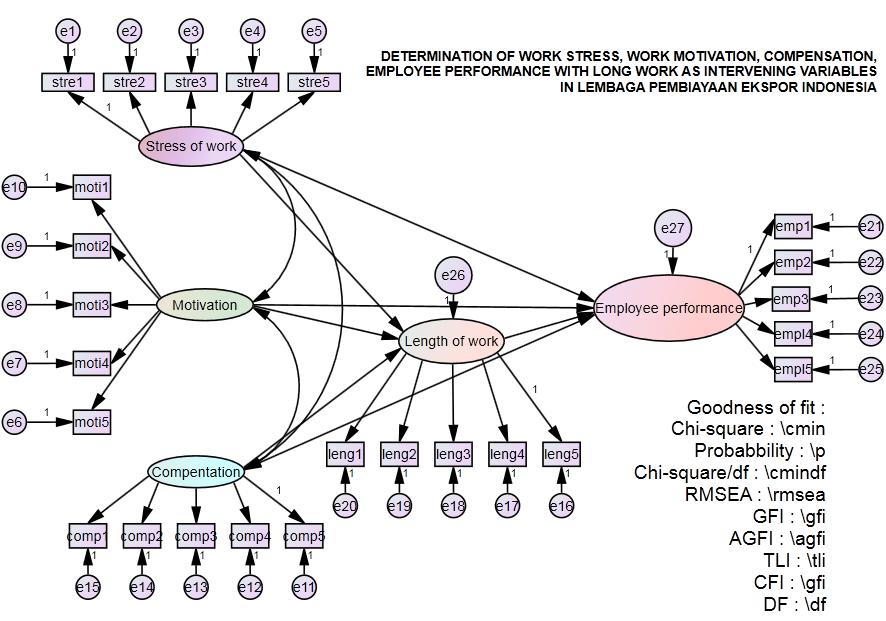
Hypothesis
A hypothesis must show a clear structure as it becomes easier to know the type of the variable and the direction of the relationship between variables, whether positive or negative. A short answer to the research problem is as follows:
1. Job Stress directly determines the length of work.
2. Work motivation directly determines the duration of work.
3. Compensation determines directly on the length of work.
4. Job stress determines directly on employee performance.
5. Work motivation directly determines employee performance.
6. Compensation determines employee performance.
7. The length of work determines the employee performance.
Research Methods
A research location is a place where researchers will conduct research or collect data location. This is determined with the aim of narrowing the scope of the discussion of the problem. In addition, determining the area and division is also due to ability, time, and cost of researchers. Therefore, researchers chose the location of research conducted at 4 (four) Regional Offices, 3 (three) Marketing Offices, and 3 (three) Divisions at the Central Office.
Population
As for the population in this study, there are 156 employees of the Indonesian Export Financing Agency.
Sample
Withdrawal of sample members by sampling technique, the results are expected to represent the characteristics of the study population (representative). Researchers used processed data using SEM with AMOS version 24 software, which states that for optimal data collection is using samples from 100-200 samples, and in this study, the researchers used census methods so that the respondents numbered 156, respondents had to fill out questionnaires that had been distributed.
Data collection technique
For the analysis of the problem under study, the data collection is carried out using techniques:
1. The interview technique is question-answer between the researchers and the parties concerned to obtain the desired data and information.
2. The distribution of questionnaires that contained questions from each research variable, where the number of questions from each of these variables was five questions. Then the questions are weighted based on a Likert scale with a weighting of values 1 to 5.
Research Variable
This research was conducted using three exogenous variables, namely work stress (X1), work motivation (X2) compensation (X3) length of work (Y) as intervening variables, one endogenous variable of employee performance (Y).
Data Analysis Techniques
The analysis used by researchers in this study is path analysis by describing a flow chart that can make it easier to see the relationships to be tested. Data analysis was performed using the Structural Equation Modeling (SEM) method, and the software used for structural analysis was Amos version 24 of Arbuckle and descriptive using SPSS 24. In this step, the suitability of the model was evaluated through the examination of various Goodness of Fit criteria. For this reason, the first step taken is to evaluate whether the data used can meet the SEM assumptions. If these assumptions are met, the model can be tested.
Table 1. Maximum Likelihood Estimates Regression Weights: (Group number 1 - Default model)
| width="73"> Estimate width="47">SE width="59">CR width="46">P. width="62">Label | > LENG width="35">width="46"> STRE width="73">.100 width="47">.116 width="59">859 width="46">.390 width="62">par_21 | > LENG width="35">width="46"> MOTI width="73">297 width="47">.093 width="59">3,186 width="46">.001 width="62">par_22 | > LENG width="35">width="46"> COMP width="73">295 width="47">.116 width="59">2,550 width="46">.011 width="62">par_23 | > EMPL width="35">width="46"> LENG width="73">.324 width="47">.121 width="59">2,685 width="46">.007 width="62">par_24 | > EMPL width="35">width="46"> STRE width="73">.250 width="47">.144 width="59">1,730 width="46">.084 width="62">par_28 | > EMPL width="35">width="46"> COMP width="73">.393 width="47">.148 width="59">2,658 width="46">.008 width="62">par_29 | > EMPL width="35">width="46"> MOTI width="73">.119 width="47">.117 width="59">1,017 width="46">.309 width="62">par_30 | ||
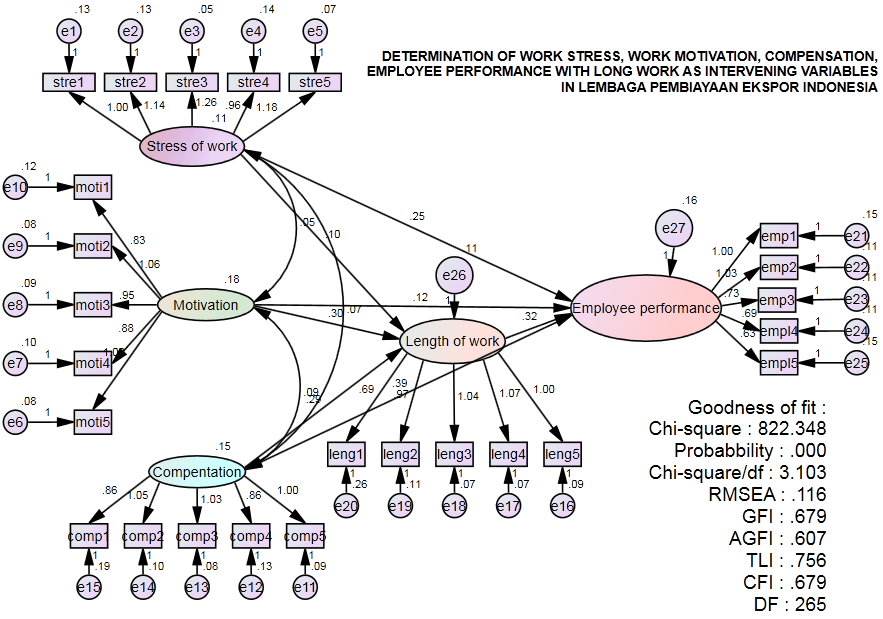
Table 2. Standardized Regression Weights: (Group number 1 - Default model)
| width="167"> Estimate | > LENG width="33">width="44"> STRE width="167">.083 | > LENG width="33">width="44"> MOTI width="167">.309 | > LENG width="33">width="44"> COMP width="167">.282 | > EMPL width="33">width="44"> LENG width="167">.253 | > EMPL width="33">width="44"> STRE width="167">.163 | > EMPL width="33">width="44"> COMP width="167">.294 | > EMPL width="33">width="44"> MOTI width="167">.977 | ||
Table 3. Squared Multiple Correlations: (Group number 1 - Default model)
| width="269"> Estimate | > LENG width="269">.319 | > EMPL width="269">.406 |
The Goodness of Fit Analysis
Based on test criteria, Chi-square (c2), Relative Chi-square (c2 / Df), RMSEA, GFI, AGFI, TLI, and CFI above and Goodness of Fit values ??Amos processing results as shown in the figure above are presented in the following table:
Table 4. Evaluation of Goodness of Fit
| A Goodness of Fit Index width="114">Cut-of-Value width="113">Results Model width="85" valign="top">Information | > Chi-square (?2) width="114">Is expected small width="113">822,348 width="85">Well | > Relative Chi-square (?2 / df) width="114">00 3.00 width="113">3,103+) width="85">Marginal | > Probability width="114">> 0.05 width="113">0,000 width="85">Not good | > RMSEA width="114">? 0.08 width="113">0,116+) width="85">Marginal | > GFI width="114">? 0.90 width="113">.679 width="85">Not good | > AGFI width="114">? 0.90 width="113">0.607 width="85">Not good | > TLI width="114">? 0.94 width="113">.756+) width="85">Marginal | > CFI width="114">> 0.94 width="113">.679+) width="85">Marginal |
Source: Research Findings, 2020
The results in the table above shows the seven criteria that are met; eight tests were used. The requirements are met by the Chi-square (c2), Relative Chi-square (c2 / Df) RMSEA, GFI, TLI, AGFI, and CFI. Because seven of the eight criteria are met the required standards, the models can be Expressed as a good model of (Solimun, 2002: 80 and Solimun, 2004: 71).
After theoretical discussion and research, the results of this study can be described as follows:
1) Determinationlatent variable Weight Stress of Work (STREE) to the latent variable Length of Work (LENG) has a standardized estimate (regression weight) of 0.083 with Cr (Critical ratio = identical to the t-count value) of 0.859 at probability = 0.390. CR value of 0.859 <2.00 and Probability = 0.390> 0.05 indicates that the determination of the Stress of Work (STREE) latent variable to the latent variable Length of Work (LENG) is positively insignificant. Theories that support this finding are the previous work period of employment at the previous company is a robust estimation of employee resignation in the future (Robbins, 2006: 145) so that employees at the Indonesian Export Financing Institution may be biased when he just joins this Institute proposing to resign due to an offer for other work that is more than a job at this institution.
2) Latent variable Weight Motivation of Work (MOTI) to the latent variable Length of Work (LENG) has a standardized estimate (regression weight) of 0.309 with Cr (Critical ratio = identical to the t-count value) of 3.186 at probability = 0.01. CR value 3.186> 2.00 and Probability = 0.001 <0.05 indicates that the determination of the intrinsic variable Motivation of Work (MOTI) to the latent variable Length of Work (LENG) is significantly affirmative. The results of this study are also supported by the theory that the work is the most critical component in explaining the level of employee resignation (Robbins, 2006: 218). The longer an employee works in a company; the less likely the employee will resign; the employee can continue to be motivated to work well to meet the needs of his family.
3) Latent variable Weight Competition (COMP) to latent variable Length of Work (LENG) has a standardized estimate (regression weight) of 0.282 with Cr (Critical ratio = identical to the t-count value) of 2.550 at probability = 0.11. CR value of 2,550> 2.00 and Probability = 0.011 <0.05 indicates that the determination of the intrinsic variable Motivation of Work (MOTI) to the latent variable Length of Work (LENG) is significantly positive. According to Hasibuan (2017: 119), compensation is all income in the form of money, direct or indirect goods received by employees as a reward for services provided to the company. The establishment of effective compensation systems is an important part of human resource management because it helps attract and retain skilled jobs. Also, the company's compensation system has an impact on strategic performance. Long working period will determine the level of compensation that will be received both in the form of bonuses and benefits, so that it can spur employees to continue working at this institution by taking into account the addition of years to years of work as employees at this institution.
4) Latent variable Length of Work (LENG) to the latent variable Employee Performance (EMPL) has a standardized estimate (regression weight) of 0.253 with Cr (Critical ratio = identical to the t-count value) of 2.685 at probability = 0.071. CR value of 2.550> 2.00 and Probability = 0.007 <0.05 indicates that the determination of the latent variable Length of Work (LENG) to the latent variable Employee Performance (EMPL) is significantly affirmative. So it can be said that Length of Work as an Intervening variable gives Stress of Work, Motivation of Work, and Competition to Employee Performance.
Determinationlatent variable Weight Stress of Work (STREE) to the latent variable Employee Performance (EMPL) has a standardized estimate (regression weight) of 0.163 with Cr (Critical ratio = identical to the t-count value) of 1.730 at probability = 0.084. CR value of 1.730 <2.00 and Probability = 0.084> 0.05 indicates that the determination of the Stress of Work (STREE) latent variable to the Employee Performance (EMPL) latent variable is positively insignificant. This is inversely proportional to what Higgins said (in Umar, 1998: 259) argues that there is a direct relationship between stress and performance, a large amount of research has investigated the relationship of work stress with performance presented in the stress-performance model (inverse U relationship) namely Yerkes law Poison (Mas'ud, 2002: 20). The inverted U pattern shows the relationship between stress level (low-high) and performance (low-high). If there is no stress, work challenges are also absent, and performance tends to decrease. The level of work stress of employees at the Indonesian Export Financing Agency is considered a strong stimulus that encourages employees at the Indonesian Export Financing Institution to respond to work challenges. Finally, the stress reaches a stable point, which is roughly by the ability of employee achievement.
5) The latent variable Compensation (COMP) to the Employee Performance (EMPL) latent variable has a standardized estimate (regression weight) of 0.294 with Cr (Critical ratio = identical to the t-count value) of 2.658 at probability = 0.008. CR value 2.658> 2.00 and Probability = 0.008 <0.05 indicates that the determination of the latent variable Compensation (COMP) to the latent variable Employee Performance (EMPL) is significantly positive. With the provision of salaries or wages, benefits, bonuses, and other facilities encourage employees to increase the achievement of work volume and successfully set targets by company expectations. (Ulfatin & Triwiyanto 2016: 120) explains that compensation is everything that is given by the institution to employees because the employee has given a source of energy and thought for progress to achieve the goals set by the institution concerned. The higher the compensation received by an employee, the employee will feel treated fairly and properly and will make the employee feel satisfied with the results he has given to the company. There are two things that companies need to keep in mind in granting compensation. First, the compensation provided must be felt fairly by employees, and secondly, the amount of compensation is not much different from what is expected by employees. If these two things can be met, then the employee will feel satisfied or vice versa. Satisfaction will motivate employees to improve their performance so that they will achieve the company's goals and employee needs.
6) The latent variables Weight Motivation of Work (MOTI) to Employee Performance (EMPL) latent variables have a standardized estimate (regression weight) of 0.097 with Cr (Critical ratio = identical to the t-count value) of 1.017 at probability = 0.309. CR value of 1.017 <2.00 and Probability = 0.309> 0.05 indicates that the determination of the Motivation of Work (MOTI) latent variable to the Employee Performance (EMPL) latent variable is positively insignificant. Work Motivation does not determine Employee Performance; this is inversely proportional, as revealed by McClelland in Mangkunegara (2011: 68). It also believes that there is a positive relationship between achievement motivation and performance achievement. This is because the achievement motivation that is grown from within oneself will form the strength of self, and if the work environment situation also supports the achievement of performance will be more leverage. The higher the motivation of employees the higher the employee's performance and vice versa, employee work motivation is not easy especially employees have responsibilities to work to meet their needs so that they do not care about motivation even though motivation has an important role in the success of an institution's goals.
7) Square Multiple Correlation: The value of Length Work (LENG) = 0.319 for Employee Performance (EMPL) = 0.406, as shown in Table 4.30 above. According to Ferdinand (2002: 114), the Squared Multiple Correlation value for the Length of Work (culture) variable R2 = 0.319 is identical to R2 in SPSS of 0.319. The amount of determination is the Squared Multiple Correlation values for the Length of Work variable times 100% = 0.319x 100 % = 31.9%. Thus, the change in Length of Work is determined by Stress of Work, Motivation of Work, and Competition of 31.9% For Employee Performance (EMPL) R2 = 0.406, the magnitude of its determination = 0.406 x 100% = 40.6%. Thus, the change in Employee of Performance is determined by Stress of Work, Motivation of Work, Competition, and Length of Work by 40.6%. The overall analysis above shows that all indicators for Stress of Work, Motivation of Work, Competition, Length of Work, and Employee Performance are Valid/significant. When seen from the structural equation model above showing Regression Weight (?), five variables are its determination significant is positive, and two variables are its determination positive but not significant. However, considering that the results of the Goodness of Fit Evaluation showed four marginal criteria, namely Relative Chi-square (?2 / df), RMSEA, TLI, and CFI of the eight criteria, and six variables are significantly positive determinants. This research is considered sufficient to meet the requirements. Thus, it is deemed not necessary to make further modifications.
Conclusion
After theoretical discussion and research, the results of this study can be concluded as follows:
a) Determination of the Stress of Work (STREE) latent variable to the Length of Work (LENG) latent variable is not significant.
b) Determination of the intrinsic variable Motivation of Work (MOTI) to the latent variable Length of Work (LENG) is a significant positive.
c) Determination of the intrinsic variable Motivation of Work (MOTI) to the latent variable Length of Work (LENG) is a significant positive.
d) Determination of the Length of Work (LENG) latent variable to the Employee Performance (EMPL) latent variable is significantly positive.
e) Determination of the Stress of Work (STREE) latent variable to the Employee Performance (EMPL) latent variable is positively insignificant.
f) Determination of the latent variable Compensation (COMP) to the Employee Performance (EMPL) latent variable is significantly affirmative.
g) Determination of the Motivation of Work (MOTI) latent variable to the Employee Performance (EMPL) latent variable is not significant.
h) Changes in Length of Work are determined by Stress of Work, Motivation of Work, and Competition by 31.9%. The sequences = 100% -31.9% = 68.1% are the contributions of other variables that have not been included in this study.
i) While the change in Employee of Performance was determined by Stress of Work, Motivation of Work, Competition, and Length of Work by 43%. The ratio = 100% -43% = 57% is the contribution of other variables that have not been included in this study.
References
- Amirullah. (2015). Methods and techniques for preparing research proposals. Nusa Creative Media. Poor.
- Amirullah, R. K. (2014). Analysis of the Effect of Job Stress and Compensation on Employee Performance (study at PT. Unggul Jaya Blora). Semarang Thesis: Diponegoro University.
- Fadhilah, M. L. (2010). Analysis of the Effect of Job Stress on Job Satisfaction with Social Support as a Moderating Variable (study at PT. Coca-Cola Amatil Indonesia, Central Plaza). Semarang Journal, Dipenogoro University
- Ghozali, I. (2011). Multivariate Analysis Applications with the IBM SPSS 19 Program. Fifth Edition, Diponegoro University Publishing Board. Semarang.
- Hudiwinarsih, Windy Aprilia Murty Gunasti, 2012.
- Hasibuan, Windi puspita Dian Sari, 2013.
- Istiani, Hesti Chess, 2017.
- Kadarisman. 2012.
- Mahesa, Deewar, 2010.
- Novianti, Ruli Alifia, 2016.
- Prasetiyo, Sigit, 2014.
- Siagian, Sondang. 2012. Human Resource Management. Jakarta: Earth Literacy.
- Siagian, Sondang P, 2013.
- Sugiyono, 2016.
- Tallo, Maria graciana yudith, 2015.
- C, Miftah. 2015.
- Ulfatin, Nurul and Teguh triwiyanto. 2016.
- Wibowo. 2007.
- Wijayanti, Ratna, 2016.
- Wibisono, Chablullah (2019) Operations Management II, K-Media Publisher, Yogyakarta
Cite this article
-
APA : Charta, N. P., Wibisono, C., & Khadafi, M. (2019). Determining Work Stress, Work Motivation, Compensation of Employee Performance with Long Work in Indonesia Export Financing Institutions. Global Economics Review, IV(I), 74-84. https://doi.org/10.31703/ger.2019(IV-I).08
-
CHICAGO : Charta, Nofanza Prima, Chablullah Wibisono, and Muamar Khadafi. 2019. "Determining Work Stress, Work Motivation, Compensation of Employee Performance with Long Work in Indonesia Export Financing Institutions." Global Economics Review, IV (I): 74-84 doi: 10.31703/ger.2019(IV-I).08
-
HARVARD : CHARTA, N. P., WIBISONO, C. & KHADAFI, M. 2019. Determining Work Stress, Work Motivation, Compensation of Employee Performance with Long Work in Indonesia Export Financing Institutions. Global Economics Review, IV, 74-84.
-
MHRA : Charta, Nofanza Prima, Chablullah Wibisono, and Muamar Khadafi. 2019. "Determining Work Stress, Work Motivation, Compensation of Employee Performance with Long Work in Indonesia Export Financing Institutions." Global Economics Review, IV: 74-84
-
MLA : Charta, Nofanza Prima, Chablullah Wibisono, and Muamar Khadafi. "Determining Work Stress, Work Motivation, Compensation of Employee Performance with Long Work in Indonesia Export Financing Institutions." Global Economics Review, IV.I (2019): 74-84 Print.
-
OXFORD : Charta, Nofanza Prima, Wibisono, Chablullah, and Khadafi, Muamar (2019), "Determining Work Stress, Work Motivation, Compensation of Employee Performance with Long Work in Indonesia Export Financing Institutions", Global Economics Review, IV (I), 74-84
-
TURABIAN : Charta, Nofanza Prima, Chablullah Wibisono, and Muamar Khadafi. "Determining Work Stress, Work Motivation, Compensation of Employee Performance with Long Work in Indonesia Export Financing Institutions." Global Economics Review IV, no. I (2019): 74-84. https://doi.org/10.31703/ger.2019(IV-I).08