
Abstract:
Due to growing worldwide industrial apprehension, adopting green innovation ` essential in addressing environmental issues. Current study investigates the impact of green management innovation (GMgt) on firm financial performance (FPP). In addition, this study examines the mediating effect of green process innovation (GPrcI) and green product innovation (GPdI) between GMgt and FPP. Data were analyzed through SPSS and AMOS. Based on a sample of 307 top and middle level employees in the Pakistani manufacturing industry. The results revealed that GMgtI has a significant impact on FFP. Second, GPrcI significantly mediates the relationship between GMgtI and FPP. Third, GpdI insignificantly mediates the relationship between GMgtI and FFP. The results also showed that green image significantly moderates the relationship between GPrcI, GPdI and FPP. Finally, the study provides implications for manufacturing firms interested in implementing green innovation practices
Key Words:
Green Management Innovation, Green Technology Innovation, Firm’s Financial Performance, Manufacturing Sector, Pakistan
Introduction
The increasing focus on environmental matters in business has consistently drawn attention to the firm's commitment to environmental awareness (Wang et al., 2021). The uncontrolled impact of industrial activities on the natural environment and the continuous worsening of global environmental issues has been highlighted as a big deal in the business sector. The environmental issues of Pakistan include climate change, ozone depletion, water pollution and toxic wastes that are harming the planet's sustainable development (Sarfraz et al., 2023). In the last few years, environmental pollution has increased to an alarming level in the country. In the context of Pakistan, the manufacturing sector makes up 12.79% of the Gross Domestic Product (Shah, 2021) and the second largest sector of the economy (Shehzad et al., 2023), which contributes almost 45% of pollution (Mehdi, 2019). The proof of incompetent utilization of resources can be seen as pollution (Chen, 2008) that influences firm benefits. Advanced technology has been ascribed to dealing with various environmental issues by lessening the consequences of contaminants (Sun et al.,2019; Zhou et al.,2021).
Green innovation is necessary to deal with environmental issues (Kong et al., 2016). Green innovation strives to enhance existing products and processes, rendering them more ecologically sustainable (Zhang et al., 2020) and eliminating or minimising the negative impacts on the environment of their operations (Fernando et al., 2019). Global warming is a current environmental issue all over the world. Due to the escalation in global warming, firms begin to face burdens from society (Hofman et al., 2020).
Organizations were compelled to embrace environmentally conscious business practices with significant economic worth (Chen & Delmas, 2012). Most firms' "going green" is considered a vital measure (Christmann, 2000). Environmental sustainability is essential, and companies that adopt green innovation strategies achieve a competitive edge (Albort-Morant et al., 2016). According to Wang et al. (2020), financial and environmental performance is important and achieved when firms implement green practices. According to Chen (2010), developing or awarding a green image is described as "a collection of brand perceptions within a consumer's cognition, intertwined with notions of environmental commitments and concerns. Firms should attach further customers and improve customer brand loyalty with the help of a green image (Chang & Fong, 2010).
Siva et al., (2016) categorized green innovation among green technology innovation and GMgtI. Green technology innovation is further divided into GPdI and GPrcI (Salvadó et al., 2012). Green technology innovation aids in conserving raw materials, energy, and resources by introducing novel or enhancing existing products and processes. It strives to foster a symbiotic relationship between the environment, economy, and production processes (Li et al., 2018; Rehman et al., 2023). The negative environmental effect can be lessened or wiped out by embracing a new management system and remoulding structure for the betterment of the production process and management, which is the objective of the firm, and it can be achieved through GMgtI (Qi et al., 2010).
Firms aspire to lead in pioneering green technology innovation and Green Management of Technology and Innovation (GMgtI) to attain numerous competitive advantages, including customer trust, loyalty, and enhanced profitability (Ahmad et al., 2023: Tu & Wu, 2021). Most of the literature focuses on GPrcI and GPdI (Rehman et al., 2021; Awan et al., 2020; Ma et al., 2017), and only a few studies have examined GMgtI (Ma et al., 2018) so GMgtI has been reviewed in detail in this study.
Compared with technological innovation, non-technological innovation did not acquire ample attentiveness. Only a few researchers have examined the impact of a non-technological practice on firms (Li et al., 2018; Ma et al., 2017; Montobbio & Solito, 2018). This study is different from the previous research in that this research is carried out in the context of Pakistan. The paper imparts to the extant literature in a way that the relationship between GMgtI and FFP is even so extensively unidentified in the literature (Xie et al., 2019). The current study aims to address this gap in the existing literature by examining the influence or effect of GMgtI on FFP. Additionally, this study broadens the current comprehension of how companies can enhance financial returns through Green Management of Technology and Innovation (GMgtI) by delving into the mediating influence of Green Product-Related Capabilities and Innovations (GPrcI) and Green Process-Related Capabilities and Innovations (GPdI), while also exploring the moderating impact of green image.
The effect of green innovation on organizational and environmental performance is pointed out by (El-Kassar & Singh, 2019) and on competitive advantage (Lukitaruna, 2018) provides the implication that the company's positive image will improve in the eyes of all the stakeholders by the creation of GPrcI and GPdI. In the extant literature, there has also been little empirical research on GPrcI and green images (Xie et al., 2019). Therefore, to bridge the gap, firstly current study analyzes the impact of the three kinds of green innovation on financial performance and, secondly how green image impacts the relationship between GMgtI and FFP. This study is conducted in the manufacturing sector. The respondents of the study are top- and middle-level management employees of Sialkot, Gujarat, and Gujranwala, known as Pakistan's golden triangle cities.
Literature Review and Hypothesis Green Management Innovation and a Firm's Financial Performance
Green management innovation refers to the firm's aim to improve the production processes by adopting a new management structure, system, and strategies (Li et al., 2018). More or less, in every firm, there exists management innovation. Green innovation can be classified into two distinct categories: green technology innovation and green non-technology innovation (Evangelista & Vezzani, 2010). Which ultimately can increase a firm’s financial performance (Ashraf et al., 2021).
In comparison to the technological innovation to which much concentration has been discussed in prior research, on the other hand, literature is scarce regarding non-technological innovation (Li et al., 2018). It's been underlined by prior studies that innovativeness significantly affects the competitive advantage and performance of the firm positively (Azadegan & Dooley, 2010; Kim & Chai, 2017; Ojha et al., 2016). The management proposes ideas that are less harmful to society or things that are smart, green and have a positive impact on society, and the impact of industrial growth does not go for the society. When such things happen, society ultimately perceives the company as positive, and the product of the company's brand is more valuable and leads to more sales. The company's performance increases when there are more sales (Somjai et al., 2020). Green management innovation leads to all Smart ideas needed by today’s industrial revolution. Companies can save many amounts through those particular ideas by using less carbonated resources (Hizarci?Payne et al., 2021). According to (Ma et al., 2018), “GMgtI has a significant impact on the firm financial performance”.
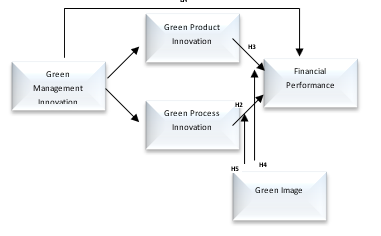
H1: GMgtI has a significant impact on FFP.
The Mediating Role of Green Process Innovation
Green process innovation is centred around improving the transformation of raw materials into feasible products during the production process (Albort-Morant et al., 2016). To optimize resource utilization, Green Process-Related Capabilities and Innovations (GPrcI) encompass methodical enhancements across the entire operational and managerial framework (Li et al., 2017). When will there be GMgtI in the company? This means the management is thinking of such ideas at least from that less pollution generates and adopt such machinery and such green practices which will ultimately lead to GPrcI (Xue et al., 2019). Moreover, when companies think of such ideas and when the top management approach is that they have to be green, smart and environment friendly then ultimately the same thing will be important down to the lower-level employees and the process which lower-level employees are using, they will definitely go for green because of the direction from top was going green (Tang et al., 2018).
It’s been evident from prior studies that there is a significant impact of GPrcI on the company's competitive advantage (Chen et al., 2006; Cheng et al., 2014; Sezen & Cankaya, 2013). The prior studies (Ulfah & Ikbal, 2012; Ma et al., 2021; Shen et al., 2021; Achi et al.., 2022) it's been supported that the GPrcI has a significant impact on the firm's performance. For improvements or enhancements in the company's performance, GPrcI puts a shade of "green" in the production process and positively influences it, according to the evidence provided by such research. From the empirical investigation of the study, it has been evident that GPrcI has an insignificant effect on the company's performance (Chang, 2011). Based on the above discussion, most of the researchers showed interest in examining the impact of GPrcI on an FFP in prior studies, the majority of the researchers examined the positive impact of green process innovation on an FFP.
H2: GPrcI significantly mediates the relationship between GMgtI and FFP.
The Mediating Role of Green Product Innovation
Green product innovation focuses on altering the design of existing products or creating new ones that utilize renewable and non-toxic materials in their production, thereby diminishing environmental consequences and concurrently striving for enhanced energy efficiency (Zhang et al., 2019). GPdI emphasizes reforming the designs of the current products or creating a whole new product that utilizes renewable and non-toxic materials in the production process to reduce the environmental impacts but also energy efficiency can be achieved (Zhang et al., 2019).
In recent years, acknowledging GPdI for the accomplishment of growth, environmental sustainability is considered one of the significant components (Dangelico & Pujar, 2010). Prohibition of firms from encountering unfavourable environmental impacts and allowing for the attainment of advanced green product success is being enabled by investment in GPdI (Wong, 2012). The prior studies show that GPdI significantly positively impacts the firm's performance (Ar, 2012; Ashraf, 2021). Evidence from the empirical investigation of a prior study shows that the relationship between a firm's performance and GPdI is curvilinear.
H3: GPdI significantly mediates the relationship between GMgtI and an FFP.
Moderating Role of Green Image
Green image refers to the firm’s positive green or environmental characteristics in the mind of the stakeholders are known as the firm’s corporate green image. Customer satisfaction is considered to be an essential determinant of green image and it is seen that the firm does not only avoid the potential problem of legal penalties and environmental protests but also customer's expectations about sustainability and environmentally friendliness by investing in the improvement of their green image (Chen, 2010).In addition, firms can increase stock prices and enhance sales by generating a positive public image with the help of a green image (Wu & Qu, 2021). potentially increment in overall customer satisfaction can be gained through the green image which means the company's corporate image perception in a more favourable manner by a customer, can lead towards their more positive perception of company’s reputation”(Foroudi et al., 2014). To influence potential return, the most crucial factors are customer loyalty and corporate reputation(Chang & Fong, 2010). Thus, more economic return from the GPdI can be gained by a firm having a better green image.
GPrcI helps generate the firm's image improvement, which is one of the best outcomes (Chen, 2008; Gupta et al., 2017). Proactive green innovators improved the firm's image (Cronin et al., 2011; Jaggi & Freedman, 1992; Shrivastava, 1995). According to (Miles & Covin, 2000), developing a positive firm image is the contribution of GPrcI. If the firm's green image is not promoted, then customer loyalty can't be gained, and corporate reputation will also be unknown. Then the quality of the green product will be unknown to the customer, and green products are cost-effective, which is the main reason for their low market performance. So, as a result, this company's sales will remain relatively high, which will take time for the firm to benefit from green product innovation and increase the FFP (Qiu et al., 2020).
GPrcI can improve a firm’s public image and reputation (Liao, 2018). When firms implement GPrcI, which is the conservation of energy, efficient utilization of resources, and less pollution emission, it lessens its production cost. Also, society demands that firms be green because this will save their environment and also it will be healthier for them. So if firms will promote their green image, then customers will be aware of this company's contribution towards the community and, ultimately, their sales will increase, and this will lead towards increasing FFP (Chen, 2008). Evidence from prior studies shows that GPrcI increases a firm's green image (Xie et al., 2019), and GPdI is also positively related to a firm's green image ( Xie et al., 2019).
H4: A green image significantly moderates the relationship between GPrcI and FFP.
H5: A green image significantly moderates the relationship between GPdI and FFP.
Research Methodology Measurements
Scales of all variables used in this study have already been checked for validity in the previous research. Seven-point Likert scale has been used to measure the variables. The scale to measure the firm’s financial performance has been adopted from a previous study (Paladino, 2007). In this scale, four items were used to measure FFP. GMgtI was measured by four items adopted from (Mol & Birkinshaw, 2009). To improve the firm's environmental performance, what kind of modern techniques of environmental management had been used by the firm is measured by these items. GPdI was measured by four items adopted from (Chiou et al., 2011). How much environmentally friendly material is being used by the firm is measured in these items. GPrcI was measured by five items adopted form (Chiou et al., 2011). The green image was measured by eight items from (Keller & Aaker, 1992; Martínez & Pina, 2005; Weiss et al., 1999). The items related to a firm's green reputation and green credibility, and corporate image
Data Collection and Sampling
All over the world, the manufacturing sector is considered to play a significant role in environmental pollution and the overutilization of natural resources, which ultimately leads to resource depletion. The sample was taken from Pakistan's manufacturing sector companies in the golden triangle cities. This research's target population consists of both top and middle-level management employees because they are the ones who have all the knowledge regarding managerial and technological factors or any innovation that is being adopted, not only this they are also aware of the firm's performance. For data collection, a purposive sampling technique was utilized. In this study, the questionnaire is designed by adopting scales of variables. Then the pilot study is also conducted. In a pilot study, questionnaires were sent to 31 middle and top-level management employees of manufacturing companies in the respective cities, and then the results were checked. The supervisors of the manufacturing companies of Gujarat, Gujranwala, and Sialkot are signing the permission letter. Afterwards, the survey is conducted from the organisation's top and middle-level management employees; both online and self-approach methods are used. The target responses are 500, while out of them, only 360 responses were received. Out of 360 responses, 53 responses are rejected due to incomplete responses.
Results and Analysis Descriptive Analysis
It has been evident from descriptive statistics that out of 307 respondents, most are male, comprising 74.92%, whereas female respondents comprised 25.08% of the total. Furthermore, according to age groups,16.29% of the respondents belong to the 20-30 age group while 25.40%, 32.57%, 18.57%, and 7.17% belong to 31-40, 35-45, 41-50, above 50 age groups respectively. The participant pool also showed that 18.57%, 35.83%, 29.32%, and 16.29% of respondents have experience of fewer than 1 year, 1-5 years,6-10 years, and above 8 years, respectively. The data showed that 18.57% of the respondents belong to a firm having <10% employees,48.86% of the respondents belong to a firm having 10-50 employees,22.80% of the respondents belong to a firm having 51-100 employees, and 9.77% of the respondents belong to the firms having 101-500 employees respectively. As shown in Table 1.
Table 1
| Profile width="134" valign="top">width="134"> Frequency width="134">Percent | > Gender width="134" valign="top">Male width="134">230 width="134">74.92 | > Female width="134">77 width="134">25.08 | > Total width="134">307 width="134">100.0 | > Age width="134" valign="top">20-30 width="134">50 width="134">16.29 | > 31-40 width="134">78 width="134">25.40 | > 35 to 45 width="134">100 width="134">32.57 | > 41-50 width="134">57 width="134">18.57 | > Above 50 width="134">22 width="134">7.17 | > Total width="134">307 width="134">100.0 | > Experience width="134" valign="top">Less than 1 width="134">57 width="134">18.57 | > 1-5 width="134">110 width="134">35.83 | > 6-10 width="134">90 width="134">29.32 | > Above 8 width="134">50 width="134">16.29 | > Total width="134">307 width="134">100.0 | > Firm Size width="134" valign="top"><10 width="134">57 width="134">18.57 | > 10-50 width="134">150 width="134">48.86 | > 51-100 width="134">70 width="134">22.80 | > 101-500 width="134">30 width="134">9.77 | > Total width="134">307 width="134">100.0 |
Reliability and Validity Analysis
After screening the descriptive results, it is essential to check the validity and reliability of the scale. Since the scale is adapted from the previous studies, one has to check its reliability and validity before SEM application. As concerns for reliability, the evaluation of the model fitness test is being done. The value of CMIN should be less than 3. GFI should be at least more than 0.8 but technically should be more than 0.9.IFI and CFI must be more than 0.9. The last value that is RMSEA, should be less than 0.08. As we can see from Table No. 2, all the values are in their threshold ranges.
Similarly, for the reliability of the Likert scale, the value of all the variables for the coefficient of Cronbach alpha is within its threshold range (>0.70), ensuring the scale's reliability. Afterwards, the reliability confirmation and in-depth analysis are performed for which indicator validity, convergent validity, internal consistency reliability, and discriminant validity are being examined. Indicator validity is confirmed as every construct factor loading displayed in Table 03 exceeds the minimum range of 0.50. The value of the CR is also within its threshold range (>0.70), as indicated in Table no.03, which ensures internal consistency. For convergent validity confirmation, the AVE value is also within its threshold range (>0.50), as shown in table no.05.At last, the discriminant validity is evaluated. The values for the discriminant validity should be less than 0.85, and the value for the variable itself should be greater than the value for the other variables. So, discriminant validity lies in our data, as shown in Table 03.
Table 2
| indicators width="126" valign="top">threshold range width="327">current values | > CMIN/DF width="126" valign="top">Less or equal 3 width="327">2.50 | > GFI width="126" valign="top">Equal or greater .80 width="327">.870 | > CFI width="126" valign="top">Equal or greater .90 width="327">.959 | > IFI width="126" valign="top">Equal or greater .90 width="327">.960 | > RMSEA width="126" valign="top">Less or equal .08 width="327">.068 |
Table 3
| width="67"> CR width="67">AVE width="67">FH width="67">GMI width="67">GPrcssI width="67">GProI width="67">GImg | > FP width="67">0.860 width="67">0.670 width="67">0.800 width="67">width="67"> width="67"> width="67">
| > GMI width="67">0.780 width="67">0.641 width="67">0.650 width="67">0.680 width="67">width="67"> width="67">
| > GPrcssI width="67">0.791 width="67">0.572 width="67">0.521 width="67">0.480 width="67">0.780 width="67">width="67">
| > GProI width="67">0.833 width="67">0.612 width="67">0.700 width="67">0.490 width="67">0.651 width="67">0.792 width="67">
| > GImg width="67">0.751 width="67">0.582 width="67">0.732 width="67">0.580 width="67">0.572 width="67">0.492 width="67">0.412 |
Hypothesis Testing
To test the hypothesis as proposed in the previous sections, SEM is used by the researchers. Numerous direct and indirect paths are examined in the research amidst FFP, GMgtI, GPrcI, GPdI, and Green image. First, direct paths are examined and afterwards, the indirect ones. Model fitness was verified first to determine whether it fulfils the adequate criteria, and afterwards, the hypothesis testing debate was initiated. As illustrated in Table No. 04, the CFI, GFI, DF, IFI, and RMSEA values are within their threshold ranges, confirming the model fitness. Now, move towards the debate on hypothesis testing. Hence, Figure No. 02 shows the model and figure no.5 elaborates on the results for the direct relationship between the variables from which each hypothesis conclusion can be achieved. Based on the value of the estimate, Standard error, and P, the acceptance or rejection of a hypothesis can be stated.
The path from GMgtI to FFP is considered H1. The value of ? = 0.420, ? = 0.03, t for this relationship is more significant than 1.96, which is 2.3. Based on this result, H1 of the study is supported. It means there is a positive relationship between GMgtI and FFP. The estimated value for this is .420, which means that if one unit of GMgtI is changed, the FFP will increase by 42%. The H2, which states that GPrcI mediates the relationship between GMgtI and a FFP, is also supported. The t value for this relation is 2.30, greater than 1.96 ? = 0.150, ? = 0.023. The value of the estimate for this is 0.150, which means that if one unit of green process innovation is changed, the relationship between GMgtI and FFP will increase by 15%. As described earlier, the research also consists of three indirect paths and the direct paths.H2 is proposed to check the mediating effect of the GPrcI on the relationship between GMgtI and FFP. The t value for this relation is 2.30, greater than 1.96, ? = 0.150, ? = 0.023. Based on this result, H2 of the study is supported. It means that GPrcI significantly positively affects the relationship between GMgtI and FFP. The value of the estimate for this is 0.150, which means that if one unit of green process innovation is changed, the relationship between GMgtI and FFP will increase by 15%. However, it is already stated that GMgtI positively impacts FFP. So, it is a partial mediation. The H3 that is GPdI mediates the relationship between GMgtI and FFP is not supported as the t value for this relation is 1.21, which is less than 1.96, ? = 0.040, ? = 0.0121. The estimated value for this is 0.04, which means that if one unit of GPdI is changed, it will increase the relationship between GMgtI and an FFP by
only 4%. Along with that researcher, this study also provides evidence that green product innovation can directly benefit the firm. However, it seems to take a long time for GPdI to benefit the company.
H4 is also supported, which is as follows: A green image moderates the relationship between GPrcI and FFP. The t value for this hypothesis is >1.96,? = 0.80, ? = 0.0222. The estimated value for this is 0.80, meaning that if a green image is changed by one unit, the relationship between green process innovation and an FFP will be increased by 80%.
H5 of the study is supported. The value of t for this hypothesis is >1.96, 0.80, ? = 0.0222. It means that green image significantly moderates the relationship between GPdI and FFP. The estimated value for this is also 0.80, which means if one unit of the green image is changed, then the relationship between GPdI and FFP will be increased by 80%
Table 4
| Path width="63" valign="top">width="66" valign="top"> width="63" valign="top"> width="66" valign="top"> width="67"> Estimate width="65">S.E. width="83" valign="top">P | > FP width="63" valign="top">width="66" valign="top"> GMI width="63" valign="top">width="66" valign="top"> width="67"> .420 width="65">.140 width="83" valign="top">*** | > FP width="63" valign="top">width="66" valign="top"> GPcssI width="63" valign="top">width="66" valign="top"> GMI width="67">.150 width="65">.065 width="83" valign="top">** | > FP width="63" valign="top">width="66" valign="top"> GProI width="63" valign="top">width="66" valign="top"> GMI width="67">0.04 width="65">.033 width="83" valign="top">Insignificant | > FP width="63" valign="top">width="66" valign="top"> GImg width="63">* width="66" valign="top">GPcssI width="67">0.80 width="65">.360 width="83" valign="top">** | > FP width="63" valign="top">width="66" valign="top"> GImg width="63">* width="66" valign="top">GProI width="67">0.80 width="65">.360 width="83" valign="top">** |
Discussion and Conclusion
Green innovation can be categorized into two main branches: green technology innovation and green non-technology innovation. Both of them can increase a firm’s financial performance. Looking upon prior studies, the researcher builds a theoretical model of checking the impact of GMgtI on FFP and the mediating roles of GPrcI and GPdI. Also, the researchers explored the moderating role of the Green image. This study's empirical analysis comprises the manufacturing sector of Pakistan's golden triangle cities. Subsequent conclusions can be drawn from this empirical analysis.
Firstly, there is a positive relationship between GMgtI and FFP. This means that in Pakistan, if the company's management is taking steps to be green, it will lead towards less or more efficient utilization of the resources and less pollution, and then it will increase their profits. This means that (Xie et al., 2019) point to checking GMgtI, which they mention in their research, confirms and now opens a new door for researchers. This result is similar to the results of the study (Ma et al., 2018). Second, this study found that GPrcI has a significant positive effect on the relationship between GMgtI and FFP, which means that if Pakistan's companies' management proposes ideas that are environment friendly, then they will pass it down towards the lower level employees and their process will also be environment friendly. Studies with outcomes akin to the present research include those conducted by Chouaibi et al. (2021), Farza et al. (2021), Tang et al. (2018), and Achi, Adeola & Achi (2022).
Thirdly, it’s been stated that Green product innovation has a non-significant mediating effect on the relationship between GMgtI and an FFP, indicating that in Pakistan, if there is green product innovation, then it will not increase the FFP because then the product will be costly and people will be less willing to buy it, also it will take time for GPdI to be beneficial for companies. The results similar to this study are (Lukitaruna, 2018),(SIMPULAN & SARAN),(Amores-Salvadó et al., 2014).
Next, it has been stated that Green Image has a significant moderating effect on the relationship between GPrcI and FFP which means that in Pakistan, if a firm is doing green process innovation followed by its promotion by building its green image, then it will lead towards customer awareness and increasing financial performance as their sales will increase. This result is similar to prior studies such as (Amores-Salvadó et al., 2014) (Chen, 2008).
Lastly, it is evident from the study that Green image has a significant moderating effect on the relationship between GPdI and FFP which means that in Pakistan, if a firm is doing green product innovation and then also promotes it by building its green image, their sales ultimately increase leading towards the customer awareness and increasing profits. This result is similar to the result of prior studies such as (Xie et al., 2019),(Amores-Salvadó et al., 2014),(Chen, 2008). The results opposite of this study are (Qiu et al., 2020).
Managerial Implications
First, due to increasing global warming, firms started to face societal pressure (Albort-Morant et al., 2018). According to Chen & Delmas (2012), organizations are pressurized to adopt eco-friendly business activities. Regarding all of this, organizations must take benefit of both green innovation types that are green technology innovation and green non-technology innovation, for enhancing their FFP.
Secondly, Firms should make it at their top priority list to pursue the green image, as it leads to increasing the customer's awareness and their eagerness to purchase green products. This all-in turn, leads to increasing the firms' market share and subsequently improving their financial performance. Other than looking for ways to improve their brand image solely, one of the significant challenges that arise includes the procedure of including the vision of the environment in their business plan (Chen, 2010).
Limitations and Future Study
Some limitations exist, such as the cross-sectional data collection method used in this study. Subsequent research endeavours could employ longitudinal or panel data collection methodologies to investigate the evolving correlation between green innovation and Financial Performance (FFP) more comprehensively. Secondly, this study is on the manufacturing sector. In the future, researchers should consider other sectors as well, as less work is conducted on the services sector in Pakistan in this field of research.
Despite all these limitations, this study is influential for every organization and government agency in the developing country, especially in Pakistan's context, that wants to go greener to protect the earth.
References
- Achi, A., Adeola, O., & Achi, F. C. (2022). CSR and green process innovation as antecedents of micro, small, and medium enterprise performance: Moderating role of perceived environmental volatility. Journal of Business Research, 139, 771–781.
- Ahmad, Saeed; Ashraf, Hafiz Ahmad; Javed, Iqbal; Waqar, Munir; Yasir, Iqbal; Usman, A. (2023). Silenced by despotic leadership: investigating the mediating effect of job tensions and moderating influence of psycap on employee silence. Russian Law Journal, 11(1), 173–193.
- Alänge, S., Jacobsson, S., & Jaryehammar, A. (1998). Some aspects of an analytical framework for studying the diffusion of organizational innovations. Technology Analysis & Strategic Management, 10(1), 3–22.
- Albort-Morant, G., Leal-Millán, A., & Cepeda- Carrión, G. (2016). The antecedents of green innovation performance: A model of learning and capabilities. Journal of Business Research, 69(11), 4912–4917.
- Albort-Morant, G., Leal-RodrÃguez, A. L., & De Marchi, V. (2018). Absorptive capacity and relationship learning mechanisms as complementary drivers of green innovation performance. Journal of Knowledge Management, 22(2), 432–452.
- Alhadid, A. Y., & Abu-Rumman, A. H. (2014). The impact of green innovation on organizational performance, environmental Management behavior as a moderate variable: an analytical study on Nuqul Group in Jordan. International Journal of Business and Management, 9(7).
- Amores-Salvadó, J., De Castro, G. M., & López, J. E. N. (2014). Green corporate image: moderating the connection between environmental product innovation and firm performance. Journal of Cleaner Production, 83, 356–365.
- Ar, I. M. (2012). The impact of green product innovation on firm performance and competitive capability: The moderating role of managerial environmental concern. Procedia - Social and Behavioral Sciences, 62, 854–864.
- Ashraf, H. A. (2021). The relationship between TQM and business performance: The mediating role of innovation performance and organizational learning culture: A pitch. Journal of Accounting and Management Information Systems, 20(1), 161-167.
- Ashraf, H. A., Ishaq, M. I., & Muhammad Khan, M. (2021). EFQM enablers and business performance relationship: Examining mediating role of organizational learning culture in Pakistani textile sector. Research Journal of Textile and Apparel, ahead-of-print(ahead-of-print).
- Awan, U., Arnold, M. G., & Gölgeci, I. (2020). Enhancing green product and process innovation: Towards an integrative framework of knowledge acquisition and environmental investment. Business Strategy and the Environment, 30(2).
- Armbruster, H., Bikfalvi, A., Kinkel, S., & Lay, G. (2008). Organizational innovation: The challenge of measuring non-technical innovation in large-scale surveys. Technovation, 28(10), 644–657.
- Azadegan, A., & Dooley, K. J. (2010). Supplier innovativeness, organizational learning styles and manufacturer performance: An empirical assessment. Journal of Operations Management, 28(6), 488–505.
- Berrone, P., Fosfuri, A., Gelabert, L., & Gomez-Mejia, L. R. (2013). Necessity as the mother of “green†inventions: Institutional pressures and environmental innovations. Strategic Management Journal, 34(8), 891–909.
- Caridi, M., Pero, M., & Sianesi, A. (2012). Linking product modularity and innovativeness to supply chain management in the Italian furniture industry. International Journal of Production Economics, 136(1), 207–217.
- Chan, H. K., Yee, R. W. Y., Dai, J., & Lim, M. K. (2016). The moderating effect of environmental dynamism on green product innovation and performance. International Journal of Production Economics, 181, 384–391.
- Chang, C.-H. (2011). The Influence of Corporate Environmental Ethics on Competitive Advantage: The Mediation Role of Green Innovation. Journal of Business Ethics, 104(3), 361–370.
- Chang, N.-J., & Fong, C.-M. (2010). Green product quality, green corporate image, green customer satisfaction, and green customer loyalty. African Journal of Business Management, 4(13), 2836–2844.
- Chen, C.-M., & Delmas, M. A. (2012). Measuring Eco-Inefficiency: A New Frontier Approach. Operations Research, 60(5), 1064–1079.
- Chen, Y.-S. (2007). The Driver of Green Innovation and Green Image – Green Core Competence. Journal of Business Ethics, 81(3), 531–543.
- Chen, Y.-S. (2010). The Drivers of Green Brand Equity: Green Brand Image, Green Satisfaction, and Green Trust. Journal of Business Ethics, 93(2), 307–319.
- Chen, Y.-S., & Chang, K.-C. (2011). The nonlinear effect of green innovation on the corporate competitive advantage. Quality & Quantity, 47(1), 271–286.
- Chen, Y.-S., Lai, S.-B., & Wen, C.-T. (2006). The Influence of Green Innovation Performance on Corporate Advantage in Taiwan. Journal of Business Ethics, 67(4), 331–339.
- Cheng, C. C. J., Yang, C., & Sheu, C. (2014). The link between eco-innovation and business performance: a Taiwanese industry context. Journal of Cleaner Production, 64, 81–90.
- Chiou, T.-Y., Chan, H. K., Lettice, F., & Chung, S. H. (2011). The influence of greening the suppliers and green innovation on environmental performance and competitive advantage in Taiwan. Transportation Research Part E: Logistics and Transportation Review, 47(6), 822–836.
- Chouaibi, S., Chouaibi, J., & Rossi, M. (2021). ESG and corporate financial performance: the mediating role of green innovation: UK common law versus Germany civil law. EuroMed Journal of Business, ahead-of-print(ahead-of-print).
- Christmann, P. (2000). Effects of “Best Practices†of Environmental Management on Cost Advantage: The Role of Complementary Assets. Academy of Management Journal, 43(4), 663–680.
- Cronin, J. J., Smith, J. S., Gleim, M. R., Ramirez, E., & Martinez, J. D. (2010). Green marketing strategies: an examination of stakeholders and the opportunities they present. Journal of the Academy of Marketing Science, 39(1), 158–174
- Damanpour, F. (2014). Footnotes to Research on Management Innovation. Organization Studies, 35(9), 1265–1285.
- Dangelico, R. M., & Pujari, D. (2010). Mainstreaming Green Product Innovation: Why and How Companies Integrate Environmental Sustainability. Journal of Business Ethics, 95(3), 471–486.
- Dangelico, R. M., Pujari, D., & Pontrandolfo, P. (2016). Green Product Innovation in Manufacturing Firms: A Sustainability- Oriented Dynamic Capability Perspective. Business Strategy and the Environment, 26(4), 490–506.
- El-Kassar, A., & Singh, S. K. (2019). Green innovation and organizational performance: The influence of big data and the moderating role of management commitment and HR practices. Technological Forecasting and Social Change, 144, 483–498.
- Evangelista, R., & Vezzani, A. (2010). The economic impact of technological and organizational innovations. A firm-level analysis. Research Policy, 39(10), 1253– 1263.
- Farza, K., Ftiti, Z., Hlioui, Z., Louhichi, W., & Omri, A. (2021). Does it pay to go green? The environmental innovation effect on corporate financial performance. Journal of Environmental Management, 300, 113695.
- Fernando, Y., Jabbour, C. J. C., & Wah, W. X. (2019). Pursuing green growth in technology firms through the connections between environmental innovation and sustainable business performance: Does service capability matter? Resources Conservation and Recycling, 141, 8–20.
- Foroudi, P., Melewar, T. C., & Gupta, S. (2014). Linking corporate logo, corporate image, and reputation: An examination of consumer perceptions in the financial setting. Journal of Business Research, 67(11), 2269–2281.
- Cainelli, G., De Marchi, V., & Grandinetti, R. (2015). Does the development of environmental innovation require different resources? Evidence from Spanish manufacturing firms. Journal of Cleaner Production, 94, 211–220.
- Gupta, A., Briscoe, F., & Hambrick, D. C. (2016). Red, blue, and purple firms: Organizational political ideology and corporate social responsibility. Strategic Management Journal, 38(5), 1018–1040.
- Pane Haden, S. S., Oyler, J. D., & Humphreys, J. H. (2009). Historical, practical, and theoretical perspectives on green management. Management Decision, 47(7), 1041–1055.
- Hizarci-Payne, A. K., İpek, İ., & Gümüş, G. K. (2020). How environmental innovation influences firm performance: A meta- analytic review. Business Strategy and the Environment, 30(2), 1174–1190.
- Horbach, J., Rammer, C., & Rennings, K. (2012). Determinants of eco-innovations by type of environmental impact — The role of regulatory push/pull, technology push and market pull. Ecological Economics, 78, 112–122.
- Jaffe, A. B., Newell, R. G., & Stavins, R. N. (2005). A tale of two market failures: Technology and environmental policy. Ecological Economics, 54(2-3), 164–174.
- aggi, B., & Freedman, M. (1992). AN EXAMINATION OF THE IMPACT OF POLLUTION PERFORMANCE ON ECONOMIC AND MARKET PERFORMANCE: PULP AND PAPER FIRMS. Journal of Business Finance & Accounting, 19(5), 697–713.
- Keller, K. L., & Aaker, D. A. (1992). The Effects of Sequential Introduction of Brand Extensions. Journal of Marketing Research, 29(1), 35.
- Kim, M., & Chai, S. (2017). The impact of supplier innovativeness, information sharing and strategic sourcing on improving supply chain agility: Global supply chain perspective. International Journal of Production Economics, 187(1), 42–52.
- Kong, T., Feng, T., & Ye, C. (2016). Advanced Manufacturing Technologies and Green Innovation: The role of internal Environmental collaboration. Sustainability, 8(10), 1056.
- Li, D., Zhao, Y., Zhang, L., Chen, X., & Cao, C. (2018). Impact of quality management on green innovation. Journal of Cleaner Production, 170, 462–470.
- Llach, J., Castro, R. de, Bikfalvi, A., & Marimon, F. (2012). The relationship between environmental management systems and organizational innovations. Human Factors and Ergonomics in Manufacturing & Service Industries, 22(4), 307–316.
- Ma, Y., Hou, G., & Xin, B. (2017). Green process innovation and innovation benefit: The mediating effect of firm image. Sustainability, 9(10), 1778.
- Ma, Y., Hou, G., Yin, Q., Xin, B., & Pan, Y. (2018). The sources of green management innovation: Does internal efficiency demand pull or external knowledge supply push? Journal of Cleaner Production, 202, 582–590.
- Ma, Y., Zhang, Q., & Yin, Q. (2021). Top management team faultlines, green technology innovation and firm financial performance. Journal of Environmental Management, 285, 112095.
- MartÃnez, E., & Pina, J. M. (2005). Influence of Corporate Image on Brand Extensions: A Model Applied to the Service Sector. Journal of Marketing Communications, 11(4), 263–281.
- May, G., Stahl, B., Taisch, M., & Kiritsis, D. (2017). Energy management in manufacturing: From literature review to a conceptual framework. Journal of Cleaner Production, 167, 1464–1489.
- Mehdi, A. M. (2019). Industrial pollution in Pakistan.
- Miles, M. P., & Covin, J. G. (2000). Environmental marketing: A source of reputational, competitive, and financial advantage. Journal of Business Ethics, 23(3), 299-311.
- Mol, M. J., & Birkinshaw, J. (2009). The sources of management innovation: When firms introduce new management practices. Journal of Business Research, 62(12), 1269–1280.
- Montobbio, F., & Solito, I. (2017). Does the Eco-Management and Audit Scheme Foster Innovation in European Firms? Business Strategy and the Environment, 27(1), 82–99
- Naveh, E., Meilich, O., & Marcus, A. (2006). The effects of administrative innovation implementation on performance: an organizational learning approach. Strategic Organization, 4(3), 275–302.
- Ojha, D., Shockley, J., & Acharya, C. (2016). Supply chain organizational infrastructure for promoting entrepreneurial emphasis and innovativeness: The role of trust and learning. International Journal of Production Economics, 179, 212–227.
- Paladino, A. (2007). Investigating the Drivers of Innovation and New Product Success: A Comparison of Strategic Orientations. Journal of Product Innovation Management, 24(6), 534–553.
- Panayides, P. M., & Venus Lun, Y. H. (2009). The impact of trust on innovativeness and supply chain performance. International Journal of Production Economics, 122(1), 35–46.
- Porter, M. E., & Van der Linde, C. (1995). Toward a new conception of the environment-competitiveness relationship. Journal of economic perspectives, 9(4), 97-118.
- Prakash, A. (2002). Green marketing, public policy and managerial strategies. Business Strategy and the Environment, 11(5), 285–297.
- Qi, G. Y., Shen, L. Y., Zeng, S. X., & Jorge, O. J. (2010). The drivers for contractors’ green innovation: an industry perspective. Journal of Cleaner Production, 18(14), 1358–1365.
- Qiu, L., Jie, X., Wang, Y., & Zhao, M. (2019). Green product innovation, green dynamic capability, and competitive advantage: Evidence from Chinese manufacturing enterprises. Corporate Social Responsibility and Environmental Management, 27(1), 146–165.
- Rehman, S. U., Ashfaq, K., Bresciani, S., Giacosa, E., & Mueller, J. (2023). Nexus among intellectual capital, interorganizational learning, industrial Internet of things technology and innovation performance: a resource- based perspective. Journal of intellectual capital, 24(2), 509-534.
- Analyzing the relationship between green innovation and environmental performance in large manufacturing firms. (2021). Technological Forecasting and Social Change, 163, 120481.
- Rekik, L., & Bergeron, F. (2017). Green Practice Motivators and Performance in SMEs: A Qualitative Comparative Anaysis. Journal of Small Business Strategy, 27(1), 1–18
- Sarfraz, M., Ozturk, I., Yoo, S., Raza, M. A., & Han, H. (2023). Toward a new understanding of environmental and financial performance through corporate social responsibility, green innovation, and sustainable development. Humanities and Social Sciences Communications, 10(1), 1–17.
- Salvadó, J. A., de Castro, G. M., Verde, M. D., & López, J. E. N. (2012). Environmental innovation and firm performance: A natural resource-based view. Palgrave Macmillan.
- Sezen, B., & Çankaya, S. Y. (2013). Effects of Green Manufacturing and Eco-innovation on Sustainability Performance. Procedia - Social and Behavioral Sciences, 99, 154– 163.
- Shah, A. (2020-21). Manufacturing and Mining.
- Sharma, S., & Henriques, I. (2004). Stakeholder influences on sustainability practices in the Canadian forest products industry. Strategic Management Journal, 26(2), 159–180.
- Shehzad, M. U., Zhang, J., Dost, M., Ahmad, M. S., & Alam, S. (2023). Linking green intellectual capital, ambidextrous green innovation and firms green performance: evidence from Pakistani manufacturing firms. Journal of Intellectual Capital, 24(4), 974-1001.
- Shrivastava, P. (1995). Environmental technologies and competitive advantage. Strategic Management Journal, 16(S1), 183-200.
- Siva, V., Gremyr, I., Bergquist, B., Garvare, R., Zobel, T., & Isaksson, R. (2016). The support of Quality Management to sustainable development: A literature review. Journal of cleaner production, 138, 148-157.
- Somjai, S., Fongtanakit, R., & Laosillapacharoen, K. (2020). IMPACT OF ENVIRONMENTAL COMMITMENT, ENVIRONMENTAL MANAGEMENT ACCOUNTING AND GREEN INNOVATION ON FIRM PERFORMANCE: AN EMPIRICAL INVESTIGATION. International Journal of Energy Economics and Policy, 10(3), 204–210.
- Stefan, A., & Paul, L. (2008). Does It Pay to Be Green? A Systematic Overview. Academy of Management Perspectives, 22(4), 45–62.
- Tang, M., Walsh, G., Lerner, D., Fitza, M. A., & Li, Q. (2017). Green Innovation, Managerial Concern and Firm Performance: An Empirical Study. Business Strategy and the Environment, 27(1), 39–51.
- Yana Ulfah, & Muhammad Ikbal. (2012). Konsep Baru Total Quality Environment Management (TQEM) untuk Menguji Kinerja Lingkungan. Jurnal Dinamika Manajemen, 3(1)
- Wang, M., Li, Y., Li, J., & Wang, Z. (2021). Green process innovation, green product innovation and its economic performance improvement paths: A survey and structural model. Journal of Environmental Management, 297, 113282.
- Weiss, A. M., Anderson, E., & MacInnis, D. J. (1999). Reputation Management as a Motivation for Sales Structure Decisions. Journal of Marketing, 63(4), 74.
- Weng, H.-H., Chen, J.-S., & Chen, P.-C. (2015). Effects of Green Innovation on Environmental and Corporate Performance: A Stakeholder Perspective. Sustainability, 7(5), 4997– 5026.
- Wong, S. K. S. (2012). The influence of green product competitiveness on the success of green product innovation: Empirical evidence from the Chinese electrical and electronics industry. European Journal of Innovation Management
- Xie, X., Huo, J., Qi, G., & Zhu, K. X. (2016). Green Process Innovation and Financial Performance in Emerging Economies: Moderating Effects of Absorptive Capacity and Green Subsidies. IEEE Transactions on Engineering Management, 63(1), 101–112
- Xie, X., Huo, J., & Zou, H. (2019). Green process innovation, green product innovation, and corporate financial performance: A content analysis method. Journal of Business Research, 101, 697–706.
- Xue, M., Boadu, F., & Xie, Y. (2019). The Penetration of Green Innovation on Firm Performance: Effects of Absorptive Capacity and Managerial Environmental Concern. Sustainability, 11(9), 2455.
- Xie, X., Zhu, Q.,& Wang, R.(2019). Turning green subsidies into sustainbility: How green process innovation improves firm's green image. Business strategy and the environment, 28, 1416-1433.
- Zhang, D., Rong, Z., & Ji, Q. (2019). Green innovation and firm performance: Evidence from listed companies in China. Resources, Conservation and Recycling, 144, 48–55.
- Zhang, Q., & Ma, Y. (2021). The impact of environmental management on firm economic performance: The mediating effect of green innovation and the moderating effect of environmental leadership. Journal of Cleaner Production, 292, 126057.
- Zhu, Q., & Sarkis, J. (2006). An inter-sectoral comparison of green supply chain management in China: Drivers and practices. Journal of Cleaner Production, 14(5), 472–486.
Cite this article
-
APA : Ashraf, H. A., Iqbal, J., & Anjum, W. (2023). Greening the Bottom Line: Investigating the Influence of Green Management Innovation on Firm Financial Performance in the Pakistani Manufacturing Sector. Global Economics Review, VIII(II), 291-306. https://doi.org/10.31703/ger.2023(VIII-II).22
-
CHICAGO : Ashraf, Hafiz Ahmad, Javed Iqbal, and Waseem Anjum. 2023. "Greening the Bottom Line: Investigating the Influence of Green Management Innovation on Firm Financial Performance in the Pakistani Manufacturing Sector." Global Economics Review, VIII (II): 291-306 doi: 10.31703/ger.2023(VIII-II).22
-
HARVARD : ASHRAF, H. A., IQBAL, J. & ANJUM, W. 2023. Greening the Bottom Line: Investigating the Influence of Green Management Innovation on Firm Financial Performance in the Pakistani Manufacturing Sector. Global Economics Review, VIII, 291-306.
-
MHRA : Ashraf, Hafiz Ahmad, Javed Iqbal, and Waseem Anjum. 2023. "Greening the Bottom Line: Investigating the Influence of Green Management Innovation on Firm Financial Performance in the Pakistani Manufacturing Sector." Global Economics Review, VIII: 291-306
-
MLA : Ashraf, Hafiz Ahmad, Javed Iqbal, and Waseem Anjum. "Greening the Bottom Line: Investigating the Influence of Green Management Innovation on Firm Financial Performance in the Pakistani Manufacturing Sector." Global Economics Review, VIII.II (2023): 291-306 Print.
-
OXFORD : Ashraf, Hafiz Ahmad, Iqbal, Javed, and Anjum, Waseem (2023), "Greening the Bottom Line: Investigating the Influence of Green Management Innovation on Firm Financial Performance in the Pakistani Manufacturing Sector", Global Economics Review, VIII (II), 291-306
-
TURABIAN : Ashraf, Hafiz Ahmad, Javed Iqbal, and Waseem Anjum. "Greening the Bottom Line: Investigating the Influence of Green Management Innovation on Firm Financial Performance in the Pakistani Manufacturing Sector." Global Economics Review VIII, no. II (2023): 291-306. https://doi.org/10.31703/ger.2023(VIII-II).22