
Abstract:
This research was conducted to see the determination of interpersonal relationships, leadership styles, and communication against work productivity with team cooperation as intervening variables in the general section in the Bintan Regency Regional Secretariat. The respondents in this study were civil servants and non-permanent employees, a general part in the Regional Secretariat of Bintan Regency, amounting to 96 people. Validity and reliability were tested using SEM-PLS, then independent variables, mediator variables, and dependent variables were analysed using the SEM-PLS. From the research results, it is known that interpersonal relationships do not directly determine teamwork, leadership style directly determines teamwork, Communication directly determines teamwork, teamwork does not directly determine work productivity, interpersonal relationships directly determine work productivity, determination gave the variables of interpersonal relationships, leadership style and Communication on work productivity was 44.7%, and teamwork was 53.2%. At the same time, the rest were explained by other variables outside this study.
Key Words:
Interpersonal Relationships, Leadership Style, Communication, Team Cooperation, Work Productivity
Background
Research Questions
The study attempts to answer the following research questions:
a. Does the interpersonal relationship directly determine teamwork in the General Section at the Bintan Regency Regional Secretariat?
b. Does the leadership style directly determine teamwork in the General Section at the Bintan Regency Regional Secretariat?
c. Does communication directly determine the effect of teamwork on the General Section at the Bintan Regency Regional Secretariat?
d. Does the interpersonal relationship directly determine work productivity in the General Section in the Bintan Regency Regional Secretariat?
e. Does the leadership style directly determine work productivity in the General Section in the Bintan Regency Regional Secretariat?
f. Does communication directly determine work productivity in the General Section in the Bintan Regency Regional Secretariat?
g. Does teamwork directly determine work productivity in the General Section at the Bintan Regency Regional Secretariat
Theoretical Basis
Work Productivity Theory
According to Hasibuan (2009: 125), "Productivity contains a mental attitude that always holds that life today must be better than tomorrow and better than today." Productivity also reflects the work ethic of employees. There also reflected the right mental attitude. Thus, both employers and employees involved strive to increase productivity, with a variety of policies that can efficiently increase employee productivity (Sulaeman, 2014: 91). Productivity is generally defined as the relationship between output (goods and services) and input (labor) work, materials, money).
Theory of Interpersonal Relations
Humans live as solitary creatures as well as social beings. As individuals, human beings are unique to other creatures. Besides, humans are also social beings who cannot live alone but need help with other creatures. Humans want to establish relationships with other individuals and need each other. This relationship is often referred to as interpersonal relationships. According to (Novriani: 2018: 13), interpersonal relationships are interactions carried out by one person to another in a work situation to generate excitement to work and work activities into a productive spirit.
Leadership Style Theory
Hasibuan (2016: 170) states that: "Leadership Style is a way a leader influences the behavior of subordinates who aim to encourage workplace passion, job satisfaction, and high employee productivity to achieve maximum organizational goals." Rivai (2014: 42) states Leadership Style is a set of characteristics used by leaders to influence subordinates so that organizational goals are achieved. It can also be said that the leadership style is a pattern of behavior and strategies that are preferred and often applied.
Communication Theory
According to Ruslan (2008: 83): "Communication is an important tool in the function of public relations." The public shelter and appreciate an excellent performance in communication activities effectively and, at the same time, excellent performance to attract public attention and other important objectives of the public relations function. According to Suprapto (2011: 6), Communication is: "A process of interaction that has meaning between fellow humans." Based on the expert's opinion, it can be concluded that Communication is an essential tool for interaction between human beings. Effective Communication in work will increase work productivity and build cooperation.
Team Cooperation Theory
According to Manurung (2013: 15), teamwork is a necessity in realizing work success. Teamwork will be a driving force that has energy and synergy for individuals who join teamwork. Without good cooperation will not bring up bright ideas. According to Bachtiar (2004: 7), the definition of cooperation is the synergy of several people's strengths in achieving a common goal. Team collaboration is the involvement of several people in contributing to carrying out the tasks of the organization in order to achieve the vision and mission of the organization and offer optimal joint results.
Hypothesis
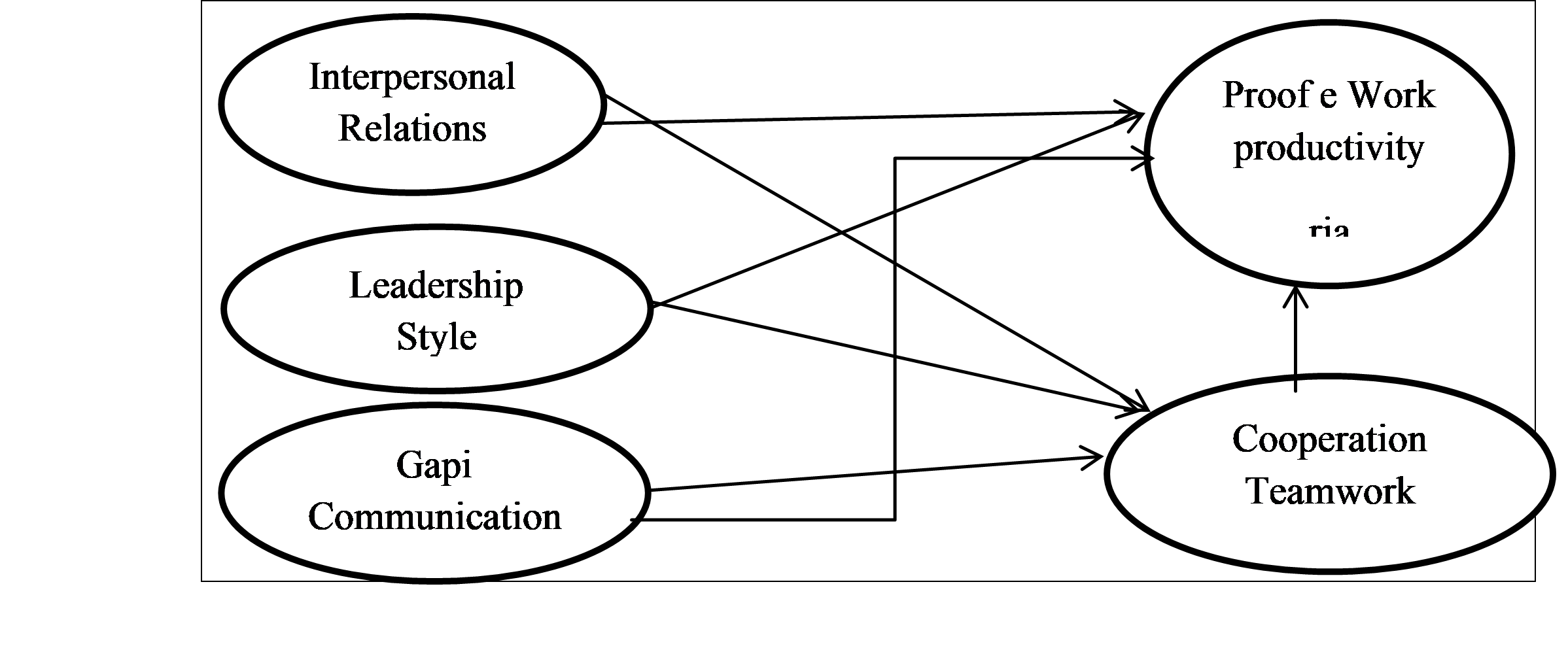
Conditional statements (provisional) which are allegations or guesses about what researchers observe to understand them. A hypothesis must show a clear structure so that it is easy to know the type of the variable and the direction of the relationship between variables, whether positive or negative. A short answer to the research problem is as follows:
a. Interpersonal Relationship Determines Teamwork
b. Leadership Style Determines Team Cooperation
c. Communication Determines Teamwork
d. Interpersonal Relationship Determines Work Productivity
e. Leadership Style Determines Work Productivity
f. Communication Determines Work Productivity
g. Team Cooperation Determines Work Productivity
Research Methods
The location of this research was carried out in the General Section at the Regional Secretariat of Bintan Regency
Population
The population is a generalization of all subjects and objects of existing research. The population in this study were all civil servants and non-permanent employees totaling 96.
Sample
Withdrawal of sample members by sampling technique, the results are expected to represent the characteristics of the study population (representative). Researchers use data processing using SEM with PLS software, which states for optimal data collection to use a sample of <100 samples. In this study, the researchers used the census method, so that respondents numbered 96, respondents must fill out a questionnaire that has been distributed.
Data Collection Technique
For the analysis of the problem under study, the data collection is done using techniques
Questionnaire
This technique is carried out to obtain primary data by asking respondents to fill out questionnaires to obtain the necessary data regarding the Determination of Interpersonal Relationships, Leadership Style, and Communication on Work Productivity with Team Cooperation as Intervening Variables in the General Section in the Bintan Regency Regional Secretariat.
Interview
This technique is carried out by observing directly in the daily activities of employees of the Regional Secretariat of Bintan Regency.
Research variable
This research was conducted using three exogenous variables, namely interpersonal relations (X1), leadership style (X2) communication (X3), namely teamwork (Y) as intervening variables, one endogenous variable work productivity (Y).
Data analysis technique
Editing
Editing is the process of checking and adjusting the obtained research data to facilitate coding and processing, as well as with statistical techniques.
Coding
Coding is the activity of marking in the form of numbers on the answers to the questionnaire and then grouped into the same category to simplify answers.
Scoring
Scoring is changing qualitative data into the quantitative form.
Tabulating
Tabulating is the presentation of data obtained in the table so that the reader is expected to be able to see the results of the research clearly after the tabulating process is occasionally carried out, then processed with the SEM-PLS (Structural Equation Model Partial Least Square) program

Results and Discussion
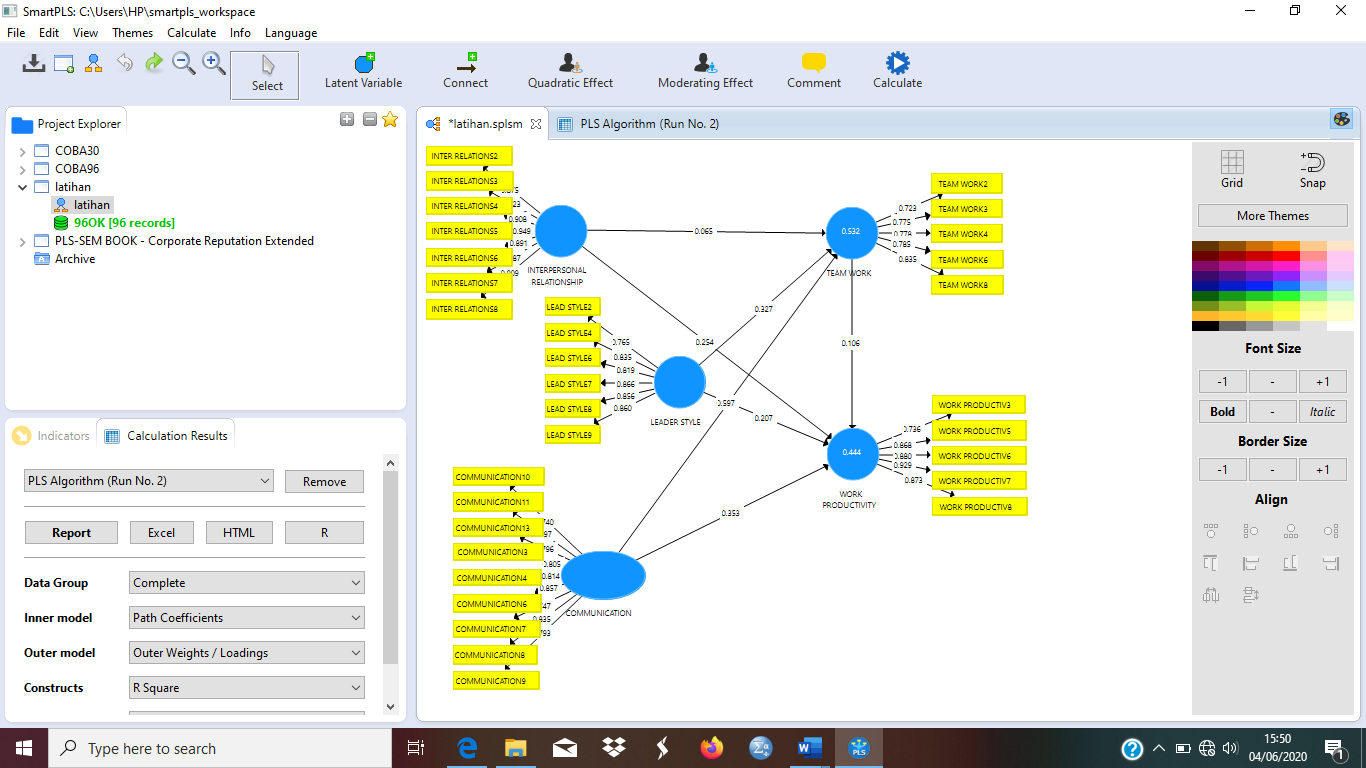
In addition to seeing the value of the factor loading construct as a validity test, in the measurement model, a reliability test is also performed. Reliability tests are carried out to prove the accuracy, consistency, and accuracy of instruments in measuring a construct. In PLS-SEM using SmartPLS, to measure the reliability of a construct can be done in two ways, namely with Cronbach's Alpha and Composite reliability. However, the use of Cronbach's Alpha to test the reliability of a construct will give a lower value (underestimate), so it is advisable to use Composite Reliability. The validity and reliability criteria can also be seen from the reliability of a construct and the value of Average Variance Extracted (AVE) of each construct.
Table 1. Composite Reliability
| Variable width="114">Cronbach's Alpha width="138">Composite Reliability width="192">Average Variance Extracted(AVE) | > Communication width="114">0.929 width="138">0.941 width="192">0.638 | > Inter_relationship width="114">0.964 width="138">0.970 width="192">0.821 | > Style leader width="114">0.910 width="138">0.929 width="192">.651 | > Teamwork width="114">0.839 width="138">.886 width="192">0.609 | > Work productivity width="114">0.910 width="138">0.934 width="192">0.739 |
Table 1. Composite Reliability
Source: Primary data processed, 2020
From Table. It can be seen that the value of all variables in reliability testing using either Cronbach's Alpha or Composite Reliability is> 0.7. Therefore, it can be concluded that the tested variables are valid and also reliable so that it can proceed to test the structural model.
Convergent Validity
Convergent validity is used to see how a measurement is positively correlated with alternative measurements of the same construct. To see an indicator of a constructed variable is valid or not, it is seen from the outer loading value. If the outer loading value is more significant than (0.4), then an indicator is valid. (Hair, Hult, Ringle, & Sarstedt, 2014).
Table 2. Outer Loading
| Variable width="102">Communicate width="96">Inter_ relationship width="60">Style leader width="54">Team work width="78">Work Product | > Inter Relations2 width="102">width="96"> 0875 width="60">width="54"> width="78">
| > Inter Relations3 width="102">width="96"> 0.923 width="60">width="54"> width="78">
| > Inter Relations4 width="102">width="96"> 0908 width="60">width="54"> width="78">
| > Inter Relations5 width="102">width="96"> 0.949 width="60">width="54"> width="78">
| > Inter Relations6 width="102">width="96"> 0891 width="60">width="54"> width="78">
| > Inter Relations7 width="102">width="96"> 0.887 width="60">width="54"> width="78">
| > Inter Relations8 width="102">width="96"> 0.909 width="60">width="54"> width="78">
| > Style Leader2 width="102">width="96"> width="60"> 0.765 width="54">width="78">
| > Style Leader4 width="102">width="96"> width="60"> 0835 width="54">width="78">
| > Style Leader6 width="102">width="96"> width="60"> 0819 width="54">width="78">
| > Style Leader7 width="102">width="96"> width="60"> 0866 width="54">width="78">
| > Style Leader8 width="102">width="96"> width="60"> 0.856 width="54">width="78">
| > Style Leader9 width="102">width="96"> width="60"> 0.860 width="54">width="78">
| > Communication3 width="102">0.805 width="96">width="60"> width="54"> width="78">
| > Communication4 width="102">0814 width="96">width="60"> width="54"> width="78">
| > Communication6 width="102">0857 width="96">width="60"> width="54"> width="78">
| > Communication7 width="102">0747 width="96">width="60"> width="54"> width="78">
| > Communication8 width="102">0835 width="96">width="60"> width="54"> width="78">
| > Communication9 width="102">0.793 width="96">width="60"> width="54"> width="78">
| > Communication10 width="102">0740 width="96">width="60"> width="54"> width="78">
| > Communication11 width="102">0.797 width="96">width="60"> width="54"> width="78">
| > Communication13 width="102">0.796 width="96">width="60"> width="54"> width="78">
| > Teamwork2 width="102">width="96"> width="60"> width="54"> 0723 width="78">
| > Teamwork3 width="102">width="96"> width="60"> width="54"> 0.775 width="78">
| > Teamwork4 width="102">width="96"> width="60"> width="54"> 0.778 width="78">
| > Teamwork6 width="102">width="96"> width="60"> width="54"> 0.785 width="78">
| > Teamwork8 width="102">width="96"> width="60"> width="54"> 0835 width="78">
| > WorkProductivity3 width="102">width="96"> width="60"> width="54"> width="78"> 0.736 | > WorkProductivity5 width="102">width="96"> width="60"> width="54"> width="78"> 0868 | > WorkProductivity6 width="102">width="96"> width="60"> width="54"> width="78"> 0880 | > WorkProductivity7 width="102">width="96"> width="60"> width="54"> width="78"> 0.929 | > WorkProductivity8 width="102">width="96"> width="60"> width="54"> width="78"> 0873 |
Source: Primary data processed, 2020
Based on the above table, it can be seen that the outer loading value for Interpersonal Relationship, Leadership Style, Communication, Team Cooperation, and Work Productivity where the value of all items in the five tested variables is more significant than 0.4, then all indicators on five variables are declared valid.
Discriminant Validity
Discriminant validity did ensure that each concept of each latent variable is different from the other variables. The model has good discriminant validity if each loading value of each indicator of a latent variable has the highest loading value with a loading value. Other than other latent variables. The discriminant validity test results are obtained as follows:
Table 3. Detroit-Monotrait Ratio (HTMT)
| width="96"> Communication width="78">Inter_relationship width="60">Style Leader width="78">Teamwork width="100">Work Productivity | > Communication width="96">width="78"> width="60"> width="78"> width="100">
| > Inter_relationship width="96">0.534 width="78">width="60"> width="78"> width="100">
| > Style Leader width="96">.113 width="78">.186 width="60">width="78"> width="100">
| > Teamwork width="96">0.712 width="78">0.461 width="60">0.428 width="78">width="100">
| > Work Productivity width="96">0.595 width="78">0.541 width="60">.339 width="78">0.581 width="100">
|
Source: Primary data processed, 2020
Based on table 4.6 could value interpersonal relationships Heteroit-Monotrait Ratio smaller than 0.9, 0.534, the value leadership style variable Heteroit-Monotrait Ratio smaller than 0.9 which is 0.113, the value of teamwork variables Heteroit-Monotrait Ratio smaller than 0.9 which is 0.712 and the value of work productivity variable Heteroit-Monotrait Ratio smaller than 0.9, 0.595, which means that all variables have good discriminant validity, or are entirely different from other constructs (the construct is unique).
Kolinierity (Colinierity / Variance Inflation Factor / VIF)
Collinearity testing is to prove the correlation between latent / construct variables is reliable or not. If there is a strong correlation, it means that the model contains problems if viewed from a methodological point of view. It has an impact on the estimation of statistical significance. This problem is called colinearity. The value used to analyze it is to look at the value of the Variance Inflation Factor (VIF). (Hair, Hult Ringle, & Sarstedt, 2014; Garson, 2016).
If the VIF value is more significant than 5.00, then there is a colinearity problem, and
vice versa there is no colinearity problem if the VIF value <5.00 (Hair, Hult, Ringle, & Sarstedt, 2014)
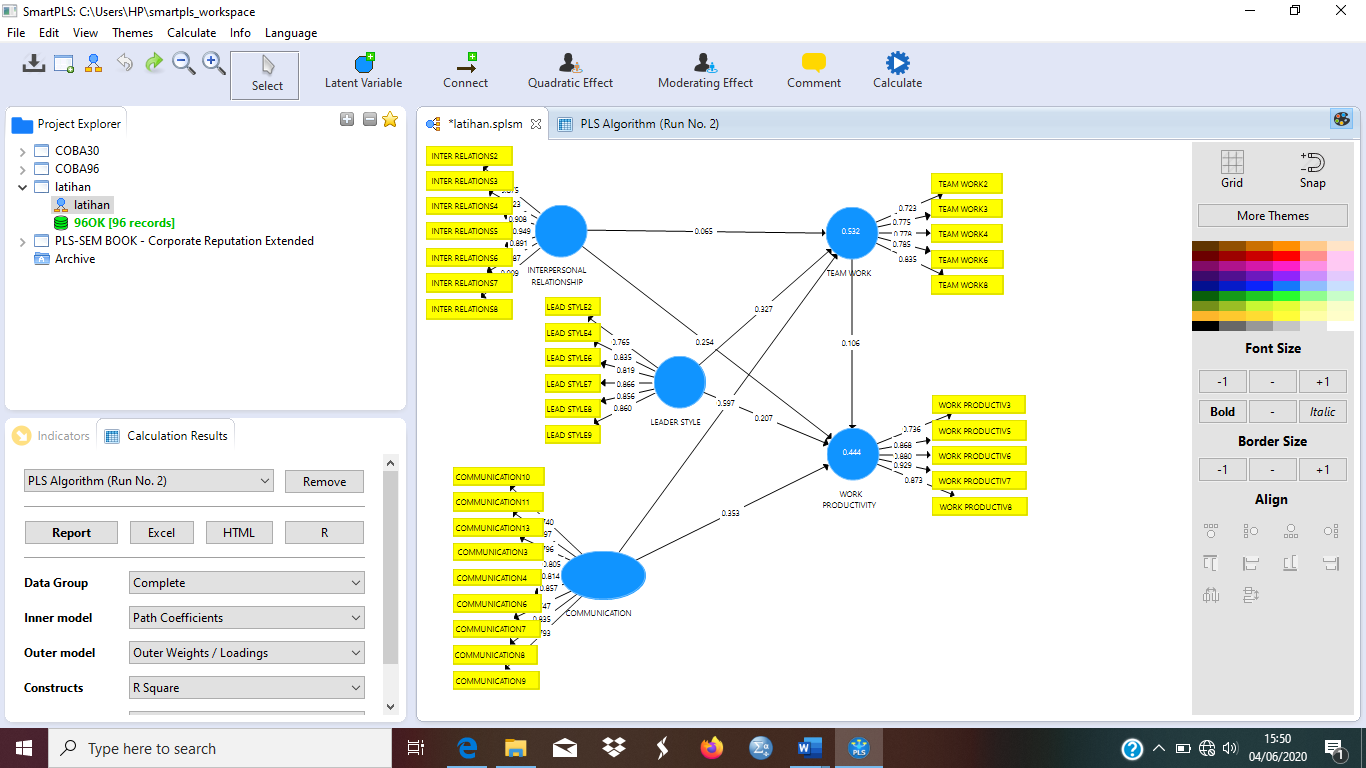
Table 4. Colinearity Statistics (VIF)
| width="78"> Communication width="96">Inter relationship width="60">Style Leader width="54">Teamwork width="100">Work Productivity | > Communication width="78">width="96"> width="60"> width="54"> 1,344 width="100">2,106 | > Inter_relationship width="78">width="96"> width="60"> width="54"> 1,378 width="100">1,387 | > Style Leader width="78">width="96"> width="60"> width="54"> 1,030 width="100">1,258 | > Teamwork width="78">width="96"> width="60"> width="54"> width="100"> 2,135 | > Work Productivity width="78">width="96"> width="60"> width="54"> width="100">
|
Source: Primary data processed, 2020
From the above data, it can be described as follows:
a. The VIF for the correlation of Interpersonal Relationship with Work Productivity is 1.387 <5.00 (there is no colinearity problem)
b. VIF for leadership style correlation with Work Productivity is 1.258 <5.00 (there is no colinearity problem) \
c. VIF for correlation of Communication with Work Productivity is 2.106 <5.00 (there is no colinearity problem)
d. VIF for the correlation of Team Cooperation with Employee Performance is 2.135 <5.00 (there is no colinearity problem)
Thus, from the data above, the structural model, in this case, does not contain a colinearity problem.
Direct Effect
Direct Effect Analysis (direct effect) is useful to test the hypothesis of the direct effect of an influential variable (exogenous) on the variable affected (endogenous) (Nur Azizah, 2019: 10).
Table 5. Bootstrapping Path Coefficients
| width="104"> Original Sample width="104">Sample Mean width="104">Standard Deviation width="104">T statistic (|O/… width="104">P Values | > Communicat… width="104">0.597 width="104">0.588 width="104">0.113 width="104">5.265 width="104">0.000 | > Communicat… width="104">0.353 width="104">0.365 width="104">0.151 width="104">2.333 width="104">0.020 | > Interperson… width="104">0.065 width="104">0.071 width="104">0.101 width="104">0.645 width="104">0.519 | > Interperson… width="104">0.254 width="104">0.253 width="104">0.119 width="104">2.121 width="104">0.034 | > Leader Style… width="104">0.327 width="104">0.344 width="104">0.112 width="104">2.929 width="104">0.004 | > Leader Style… width="104">0.207 width="104">0.210 width="104">0.086 width="104">2.407 width="104">0.016 | > Team Work-… width="104">0.106 width="104">0.094 width="104">0.127 width="104">0.834 width="104">0.404 |
Source: Primary data processed, 2020
In PLS statistical testing, every hypothesized relationship is carried out using simulations. In this case, the bootstrap method is performed on the sample. Bootstrapping testing is also intended to minimize the problem of research data abnormalities. The bootstrapping test results from the PLS analysis are as follows:
a. Hypothesis 1 Testing (There is an effect of interpersonal relationships on increasing teamwork). The first hypothesis testing results showed that the relationship between Interpersonal Relations with Teamwork Variable showed a path coefficient of 0.065 with a P-Value of 0.519. This value is higher than 0.05. These results mean that interpersonal relationships have a positive but not significant relationship to teamwork, which means it is not by the first hypothesis that interpersonal relationships do not directly affect team collaboration. This means that Hypothesis 1 is rejected.
b. Hypothesis 2 Testing (there is an effect of leadership style on increasing teamwork. The first hypothesis testing results indicate that the relationship between leadership style variables and teamwork variables shows a path coefficient of 0.327 with a P-Value of 0.004. The value is smaller than 0.05. This result means that the leadership style has a positive and significant relationship to teamwork, which means that it is by the second hypothesis. Interpersonal relationships affect direct teamwork. This means that Hypothesis 2 is accepted.
c. Hypothesis 3 Testing (There is a communication effect on increasing teamwork). The first hypothesis testing results show that the relationship between the Communication variable and the Teamwork Variable shows a path coefficient of 0.597 with a P-Value of 0.000. This value is smaller than 0.05. This result means that Communication has a positive and significant relationship to teamwork, which means it is by the third hypothesis, where Communication affects teamwork directly. This means that Hypothesis 3 is accepted.
d. Hypothesis 4 Testing (There is an effect of interpersonal relationships on increasing work productivity). The results of testing the first hypothesis indicate that the relationship between variables Interpersonal Relations with Work Productivity Variable shows a path coefficient of 0.254 with a P-Value of 0.034. This value is smaller than 0.05. These results mean that interpersonal relationships have a positive and significant relationship to work productivity, which means that the fourth hypothesis where interpersonal relationships affect work productivity directly. This means that Hypothesis 4 is accepted.
e. Hypothesis 5 Testing (There is an effect of leadership style on increasing work productivity). The results of the first hypothesis testing showed that the relationship between leadership style variables and work productivity variables showed a path coefficient of 0.207 with a P-Value of 0.016. This value is smaller than 0.05. This result means that the leadership style has a positive and significant relationship to work productivity, which means it is by the fifth hypothesis. The leadership style directly affects work productivity. This means that Hypothesis 5 is accepted.
f. Hypothesis Testing 6 (There is a Communication Effect of an increase in work productivity) The results of the first hypothesis testing indicate that the relationship between the Communication variable and the Work Productivity Variable shows a path coefficient of 0.353 with a P-Value of 0.020. This value is smaller than 0.05. This result means that Communication has a positive and significant relationship to work productivity, which means that it is by the sixth hypothesis where Communication has a direct effect on work productivity. This means that Hypothesis 6 is accepted.
g. Hypothesis 7 Testing (There is an effect of teamwork on increasing work productivity)
The results of the first hypothesis testing showed that the relationship between leadership style variables and work productivity variables showed a path coefficient of 0.106 with a P-Value of 0.404. This value is higher than 0.05. This result means that teamwork has a positive but not significant relationship to work productivity, which means it is not by the seventh hypothesis, where teamwork does not directly affect work productivity. This means that Hypothesis 7 is rejected.
Indirect Effect
Indirect Effect Analysis is useful to test the hypothesis of the indirect effect of an influential variable (exogenous) on the affected variable (endogenous), which is mediated/mediated by an intervening variable (mediator variable) (Nur Azizah, 2019: 11).
Table 6. Indirect Effect
| width="141"> Original Sample width="110">T-Statistics width="121">P-Values | > Inter_relation Teamwork Work Productivity width="141">0.063 width="110">0.768 width="121">.443 | > Leader Style Teamwork Work Productivity width="141">0.007 width="110">.362 width="121">0.717 | > Communication Teamwork Work Productivity width="141">0.035 width="110">0.632 width="121">0.528 |
Source: Primary data processed, 2020
Based on table 4.11, it can be concluded that the P-Value of interpersonal relations is 0.443; the value is higher than 0.05. This result means that teamwork determines indirect interpersonal relationships. P-Value value of leadership style is 0.717; the value is higher than 0.05. This result means that teamwork determines the leadership style indirectly. P-Value value of Communication is 0.528; the value is higher than 0.05. This result means that teamwork determines indirect Communication.
Total Effect
The total effect is the total of direct effect (direct effect) and indirect effect (indirect effect) (Nur Azizah, 2019: 12).
Table 7. Total Effect.
| Variable width="183" nowrap="" colspan="2">Koefisen Value width="104" nowrap="">Variable width="123" nowrap="">Coefficient Value | > X1 -> X4 width="99" nowrap="">0.065 width="83" nowrap="">width="104" nowrap=""> width="123" nowrap="">
| > X4 -> Y width="99" nowrap="">0.106 width="83" nowrap="">width="104" nowrap=""> width="123" nowrap="">
| > width="99" nowrap=""> Total Effect width="83" nowrap="">0.171 width="104" nowrap="">X1 -> Y width="123" nowrap="">0.254 | > X2 -> X4 width="99" nowrap="">0.207 width="83" nowrap="">width="104" nowrap=""> width="123" nowrap="">
| > X4 -> Y width="99" nowrap="">0.106 width="83" nowrap="">width="104" nowrap=""> width="123" nowrap="">
| > width="99" nowrap=""> Total Effect width="83" nowrap="">0.313 width="104" nowrap="">X2 -> Y width="123" nowrap="">0.327 | > X3 -> X4 width="99" nowrap="">0.597 width="83" nowrap="">width="104" nowrap=""> width="123" nowrap="">
| > X4 -> Y width="99" nowrap="">0.649 width="83" nowrap="">width="104" nowrap=""> width="123" nowrap="">
| > width="99" nowrap=""> Total Effect width="83" nowrap="">1,246 width="104" nowrap="">X3 -> Y width="123" nowrap="">0.353 |
Based on table 4.12 that the results of the calculation of the coefficient value for each variable both directly and indirectly contribute to the value of the variable work productivity. It can be explained that the total influence of interpersonal relations and teamwork has a coefficient of 0.171 or 17.1%, contributing to work productivity. The variable style of leadership and teamwork has a coefficient of 0.313 or 31.3%, contributing to work productivity. Variable Communication and teamwork have a coefficient of 1246, or 214.6% contribute to work productivity.
Table 8. R-Square
| Endogenous Variables width="237">R Square | > Teamwork width="237">0.532 | > Work productivity width="237">0.447 |
Based on table 4.7 it can be concluded that the model of determination of interpersonal relationships, leadership style, and Communication on work productivity gives a value of 0.447, which can be interpreted that the construct productivity variables of work that can be explained by the interpersonal relationship variables, leadership style, and Communication are 44.7%. In contrast, the rest is explained by other variables outside this study. Likewise, with the model of determination of interpersonal relationships, leadership and Communication styles towards teamwork gave a value of 0.532, which can be interpreted that the construct variables of teamwork that can be explained by the construct variables of interpersonal relationships, leadership, and communication styles are 53.
Discussion Determination of Interpersonal Relationships with Team work
Based on the statistical calculations, it can be concluded that the construct of Interpersonal Relationships has a positive but not significant effect on the construct of Team Cooperation directly. This can be seen from the path coefficient of 0.065 with a P-Value of 0.519. This value is higher than 0.05. Thus, the H1 hypothesis in this study was rejected. Therefore, the first hypothesis which states that there is a determination of interpersonal relationships with teamwork is not proven right. This shows that interpersonal relationship variables do not have a significant direct effect on teamwork. The reason for rejecting this hypothesis is alleged because an employee who does not have an excellent interpersonal relationship does not always have a low level of cooperation towards his institution. Veolia supports this (Supriyadi: 2016). Interpersonal relationships are interactions conducted by someone to other people in work situations to arouse the excitement of work and work activities into productive enthusiasm.
Determination of Leadership Style towards Teamwork
Based on the results of statistical calculations, it can be concluded that the construct of Interpersonal Relationships has a positive but not significant effect on the construct of Team Cooperation directly. This can be seen from the path coefficient of 0.327 with a P-Value of 0.004. This value is smaller than 0.05. Thus, the H2 hypothesis in this study was accepted. Therefore, the second hypothesis, which states that there is a Determination of the leadership style of teamwork, is proven to be true. This shows that the leadership style variable has a significant direct effect on teamwork. The reason for accepting this hypothesis is that a boss who has an excellent leadership style will increase teamwork, in the general section of the District Secretariat. Hasibuan (2016: 170) states that: "Leadership Style is a way a leader influences the behavior of subordinates who aim to encourage workplace passion, job satisfaction, and high employee productivity, in order to achieve maximum organizational goals.
Determination of Communication Against Teamwork
Based on the results of statistical calculations, it can be concluded that the construct of Communication has a positive and significant effect on the construct of teamwork directly. This can be seen from the path coefficient of 0.597 with a P-Value of 0.000. This value is smaller than 0.05. The value is smaller than 0.05. Thus, the H3 hypothesis in this study was accepted. Therefore, the third hypothesis, which states that there is a determination of Communication towards teamwork, is proven to be true. This shows that the communication variable has a significant direct effect on teamwork. The reason for accepting this hypothesis is alleged because an employee who has excellent Communication will enhance teamwork. An employee who has good Communication will be able to coordinate well to create good teamwork. This is supported by Suprapto (2011: 6) communication is an interaction that has meaning between fellow humans so that Communication is a process of interaction among humans; effective Communication at work will build cooperation.
Determination of Interpersonal Relationship to Work Productivity
Based on the results of statistical calculations, it can be concluded that the construct of interpersonal relationships has a positive and significant effect on the construct of work productivity directly. This can be seen from 0.254 with a P-Value of 0.034. This value is smaller than 0.05. Thus, the H4 hypothesis in this study was accepted. Therefore, the fourth hypothesis, which states that there is a determination of the interpersonal relationship to work productivity is proven right. This shows that interpersonal relationship variables have a significant direct effect on work productivity. The reason for accepting this hypothesis is thought to be that an employee who has an excellent interpersonal relationship will affect high productivity in his work. Good interpersonal relationships help employees in completing their work. This is supported by Barron and Byrne (Supriyadi 2016) supported this; factors that influence interpersonal relationships are internal and external. Internal factors are the need to interact; someone tries to maintain a relationship, join a group, participate in activities, enjoy activities with family friends, show cooperation behavior, support each other. In an organization, a person needs to interact with others or coworkers to be able to work together in completing work to increase work productivity with the help of coworkers.
Determination of Leadership Style on Work Productivity
Based on the results of statistical calculations, it can be concluded that the construct of leadership style has a positive and significant effect on the construct of work productivity directly. This can be seen from 0.254 with a P-Value of 0.034. This value is smaller than 0.05. Thus, the H5 hypothesis in this study was accepted. Therefore, the fifth hypothesis, which states that there is a determination of the leadership style of Work productivity, is proven right. This shows that the leadership style variable has a significant direct effect on work productivity. The reason for the acceptance of this hypothesis is thought to be because the person who leads a superior will influence the high productivity in his work. Leaders who involve and foster employees in work and decisions to be taken will undoubtedly increase productivity. This is supported by Handoko (2002: 193) job satisfaction is a pleasant or unpleasant emotional state with employees looking at their work. High and low job satisfaction of an employee is influenced by many factors, ranging from compensation received to the work environment that is around the employee. Increased job satisfaction performed by a company is one sign that the company has been able to manage employees or human resources in the company properly. 193) job satisfaction is a pleasant or unpleasant emotional state with employees looking at their work. High and low job satisfaction of an employee is influenced by many factors, ranging from compensation received to the work environment that is around the employee. Increased job satisfaction performed by a company is one sign that the company has been able to manage employees or human resources in the company properly. 193) job satisfaction is a pleasant or unpleasant emotional state with employees looking at their work. High and low job satisfaction of an employee is influenced by many factors, ranging from compensation received to the work environment that is around the employee. Increased job satisfaction performed by a company is one sign that the company has been able to manage employees or human resources in the company properly.
Determination of Communication against Work Productivity
Based on the results of statistical calculations, it can be concluded that the construct of Communication has a positive and significant effect on the construct of work productivity directly. This can be seen from 0.254 with a path coefficient of 0.353 with a P-Value of 0.020. This value is smaller than 0.05. Thus, the H6 hypothesis in this study was accepted. Therefore, the sixth hypothesis, which states that there is a determination of Communication towards work productivity, is proven right. This shows that the communication variable has a significant direct effect on work productivity. The reason for accepting this hypothesis is thought to be that excellent Communication will influence high productivity in his work. Good Communication will inhibit the occurrence of miss-communication at work so that the target work is appropriate to the target, and excellent Communication provides knowledge for work that is less understood so that it helps in completing work. This is supported by Ruslan (2008: 83), who says that Communication is a tool in the public relations function. "The public shelter and appreciate a good performance in communication activities effectively. At the same time, good performance is to attract public attention and other important objectives of the public relations function," effective Communication at work will increase one's work productivity.
Determination of Team Collaboration on Work Productivity
Based on the results of statistical calculations, it can be concluded that the construct of teamwork has a positive but not significant effect on the construct of work productivity directly. This can be seen from 0.254 with a path coefficient of 0.106 with a P-Value of 0.404. This value is higher than 0.05. Thus, the H7 hypothesis in this study was rejected. Therefore, the seventh hypothesis, which states that teamwork is determined towards work productivity, is not proven right. This shows that the teamwork variable does not have a significant direct effect on work productivity. The reason for rejecting this hypothesis is thought to be that teamwork is needed in addition to making work more accessible, besides teamwork shows the cohesiveness of an employee with other employees to achieve work targets in increasing work productivity. Bachtiar supports this (2004: 7). The definition of cooperation is the synergy of the strengths of several people in achieving a common goal. Team collaboration is the involvement of several people in contributing to carrying out the tasks of the organization in order to achieve the vision and mission of the organization and offer optimal joint results, without good teamwork will not bring up bright ideas to achieve work targets. 7) the definition of cooperation is the synergy of strengths of several people in achieving a common goal. Team collaboration is the involvement of several people in contributing to carrying out the tasks of the organization in order to achieve the vision and mission of the organization and offer optimal joint results, without good teamwork will not bring up bright ideas to achieve work targets. 7) the definition of cooperation is the synergy of strengths of several people in achieving a common goal. Team collaboration is the involvement of several people in contributing to carrying out the tasks of the organization in order to achieve the vision and mission of the organization and offer optimal joint results, without good teamwork will not bring up bright ideas to achieve work targets.
References
- Arifin. (2016). The Effect of Competence, Communication, and Trust on Team Cooperation (Study at the Tulungagung District Inspectorate). Islamic University Attends Kediri.
- Azuar, J. (2019). Structural Equation Model Partial Least Square (SEM-PLS) Training Module Using Smartpls. Batam University,
- Oktrima, M. (2018). The Effect of Communication on Employee Productivity in the CV. Bintang Pratama Promosindo, Pamulang University.
- Cucu, S. (2019). Influence of Leadership Style, and Organizational Culture on Employee Productivity of Public Companies in Logistics Affairs. Singapore State University, Karawang
- Dwi, Dian, Putra The Influence of Organizational Culture, Motivation, and Communication on Work Productivity of the Wonogiri Regency Environmental Service. Surakarta Islamic University, Surakarta, 2019.
- F Fahmi Maulana Septia, The Effect of Interpersonal Communication on Employee Productivity in the Bandung City Manpower Office. Bandung State Islamic University, 2014.
- Firdaus et al. The Effect of Leadership Style on Employee Productivity of the Manpower and Transmigration Office Murung Raya, Central Kalimantan Province. Singapore State University, Karawang, 2018.
- Fitria, Hardiati, The Effect of Interpersonal Trust on Team Work on Pizza Hut Employees in Yogyakarta Branch, Semarang State University, 2017.
- Hamali, A, Yusuf, Understanding of Human Resource Management, Yogyakarta: Matter 1, Caps, 2016.
- Hanna Fransiska, et al Teamwork mediated the Impact of Transformational and Transactional Leadership on the Work Performance of Private Companies in the City of Bandung. Vol. 18 Number 2, May 2019.
- Hartatik, Indah Puji, Organization and Basic Motivation for Increasing Productivity, Jakarta: Bumi Aksara, 2014.
- Hasibuan, Malayu, Organizations, and Basic Motivation for Increasing Productivity, Jakarta: Bumi Aksara, 2009
- Hasibuan, Malayu, Human Resources Management, Jakarta: Bumi Aksara, 2016.
- Indriyani, Linda, The Effect of Career Development and Organizational Communication on Employee Job Satisfaction of PT. Cogindo Daya Bersama. Syam Hodayatullah State Isam Negeri University, 2015
- Layla, Angraeni, The Effect of Team Cooperation on the Employee Productivity of PT. PLN (Persero) Transmission in Central Java. Telkom University. e-Proceeding of Management: Vol.6, No.1 April 2019.
- Manurung, Hendro, Natael, The Effect of Team Cooperation on the Effectiveness of Employee Work at PT Bank Perkreditan Rakyat Solider Pancur Batu., Medan: Universitas Sumatera Utara Medan, 2013.
- Minarti Luhat, The Effect of Leadership and Communication Style on Employee Productivity at PT. Gunta Samba Jaya Miau Baru Estate in Miau Baru Village. Volume 5, Number 3, 2017: 840-85,2017.
- Nikolus, Duli, Analysis of the Effect of Leadership Style on the Performance of Educators and Education Personnel in SD, SMP, and SMA Yos Sudarso-Batam with Team Cooperation as Intervening Variables. STIE Bentara Persada Batam. Journal of Computer Science and Business, Volume 10, Number 2, Nov 2019.
- Tilapia, Fikrotul, The Effect of Work Responsibility, Work Environment, and Interpersonal Relationships on Work Productivity of UD. Kudus Electronic Arofah. Muria Kudus University, 2014.
- Novriani, The Influence of Leadership, Interpersonal Relations, Work Discipline and the Work Environment on Employee Job Satisfaction of the Investment Office and One-Stop Integrated Services in Riau Islands Province. Raja Ali Haji Maritime University, 2018.
- Rahmat Hidayat, et al, The Relationship of Communication to Employee Productivity in Bingka Nayadam Batam. Vol. 4, No. 1, July 2016, 15-20 p-ISSN: 2337- 7887,2016.
- Raksi, Ulfa, Widyaswari, et al, The Effect of Organizational Culture and Leadership Style on Team Cooperation (Study of Gondorukem and Turpentine II Factory Employees, Ponorogo. Brawijaya University, 2019.
- Rivai, Veithzal, Leadership in Organizational Behavior, Jakarta: Rajawali Press, 2014.
- Rivai. Human Resource Management for Companies: From Theory to Practice (Issue 3). PT. Main Gramedia Library. Jakarta, 2014.
- Salfadri, et al, The Effect of Leadership Style, and Employee Commitment on Employee productivity of PT. Kunango Male. Semarang State University, 2019.
- Shintia Hotono, et al. The Mediation Effect of Team Cooperation in the Relationship between Leadership Style and Project Performance. Udayana Bali, 2017.
- Sugiyono, Qualitative Quantitative Research Methods and R&B. Bandung. Alfabeta, 2012.
- Sugiyono, Administrative Research Methods. Bandung: Alfa Beta, 2014.
- Sukarja, R, The Effect of Leadership and Communication on Job Satisfaction and Employee Performance of the Riau Provincial Education Office, Riau: Vol 7 No.2 May 2015.
- Sulaeman, Ardika. The Effect of Wages and Work Experience on the Productivity of Carving Craft Employees in Subang Regency. Journal of Trikonomika Vol. 13, No. June 1. ISSN 2355-7737,2014
- Sutrisno, Edy, Human Resource Management First Edition, Jakarta: Kencana, 2017
- Sutrisno, Edy, Human Resource Management, Jakarta: Kencana, 2011.
- Tjutju and Suwanto, Human Resource Management Application Theory and Research Issues. Bandung: Alfabeta, 2016.
Cite this article
-
APA : Maisyarah., Wibisono, C., & Satriawan, B. (2019). Determination of Interpersonal Relations, Leadership Style, Communication of Work Productivity with Team Cooperation in the Bintan Regency Secretariat, Indonesia. Global Economics Review, IV(II), 39-55. https://doi.org/10.31703/ger.2019(IV-II).04
-
CHICAGO : Maisyarah, , Chablullah Wibisono, and Bambang Satriawan. 2019. "Determination of Interpersonal Relations, Leadership Style, Communication of Work Productivity with Team Cooperation in the Bintan Regency Secretariat, Indonesia." Global Economics Review, IV (II): 39-55 doi: 10.31703/ger.2019(IV-II).04
-
HARVARD : MAISYARAH., WIBISONO, C. & SATRIAWAN, B. 2019. Determination of Interpersonal Relations, Leadership Style, Communication of Work Productivity with Team Cooperation in the Bintan Regency Secretariat, Indonesia. Global Economics Review, IV, 39-55.
-
MHRA : Maisyarah, , Chablullah Wibisono, and Bambang Satriawan. 2019. "Determination of Interpersonal Relations, Leadership Style, Communication of Work Productivity with Team Cooperation in the Bintan Regency Secretariat, Indonesia." Global Economics Review, IV: 39-55
-
MLA : Maisyarah, , Chablullah Wibisono, and Bambang Satriawan. "Determination of Interpersonal Relations, Leadership Style, Communication of Work Productivity with Team Cooperation in the Bintan Regency Secretariat, Indonesia." Global Economics Review, IV.II (2019): 39-55 Print.
-
OXFORD : Maisyarah, , Wibisono, Chablullah, and Satriawan, Bambang (2019), "Determination of Interpersonal Relations, Leadership Style, Communication of Work Productivity with Team Cooperation in the Bintan Regency Secretariat, Indonesia", Global Economics Review, IV (II), 39-55
-
TURABIAN : Maisyarah, , Chablullah Wibisono, and Bambang Satriawan. "Determination of Interpersonal Relations, Leadership Style, Communication of Work Productivity with Team Cooperation in the Bintan Regency Secretariat, Indonesia." Global Economics Review IV, no. II (2019): 39-55. https://doi.org/10.31703/ger.2019(IV-II).04