
Abstract:
The paper examined the impact of relational capitals on community economic development. For this purpose, the handloom business community was taken as a case study from Peshawar Valley. Data was collected through purposive sampling from169 handlooms firms. The results concluded that the impact of relational capital is significant, and the relationship is positive. This study hereby suggests that government and policymakers should invest in making ties and a strong network of firms within and outside of the community; hence with high investment in making strong social-relational capital can develop the entire entrepreneurial communities.
Key Words:
Social Relational, Community Economic Development, Handloom Business Community
Introduction
Every society around the globe aims to develop its community standard. Societies hereby utilize all means to get a steady rate of growth and development. They have the desire to safeguard against any chance of retrogression through levelling prosperities; hence persistent question supplicate; why are all societies not equally prosperous (Smith, 1776).
Sessional Paper No. one of Kenya (1986) focused on community participation in the process of development and approved that the urban-rural disparity in development must be a bridge. For the first time, the role of civil society and the private sector in driving economic development was recognized by the government of Kenya. In order to promote investment in rural infrastructure and promotion of small scale enterprises, the government of Kenya particularly sought to partner with the civil society and the private sector in mobilizing resources (the Republic of Kenya, 1986).
Various policy initiatives were formulated and implemented within the framework of Sessional Paper number one, such as the Kenya Rural Development Strategy (KRDS) developed in 1998. Kenya Rural Development Strategy analyzed the constraints of the previous development programs and recognized limited participation of the beneficiaries in programs as one of the major constraints to the success of previous rural development Efforts (World Bank, 2002). Kenya Rural Development Strategy specifically set out the strategy to attract the attention of participant toward such programs. The Kenya Community Trust Fund (KCTF) was recommended to facilitate the participants; this trust commenced operations in the year 2002. Kenya Community Trust Fund was intended to improve the standard of living and poverty alleviation; that’s how Kenya Community Trust Fund assists local communities to implement small projects that improve their standards of living and thereby contribute towards poverty alleviation.
Moreover, the importance of communities in the process of development was recently recognized around the globe and hence installed by the Kenya government. To decentralize and involve communities in the process of economic development, the Kenya government hereby initiated the Constituency Development Fund (CDF), which is the most recent efforts (the Republic of Kenya, 2005). So far, the Constituency Development Fund represents involving the people and community in the process of a developmental project. The boldest attempt was made by the government, where direct access was given to the community member to design and implement policies. Unlike in the other programs where the projects are designed, implemented and managed by varied government arms and/or departments such as Local Authorities Transfer Fund (LATF) while under Constituency Development Fund, members of a constituency identify, design, implement and manage their projects. Community vice the importance of rural areas are the most consideration in the development process; hence Constituency Development Fund gives more weight to the rural and relatively poor constituencies in the allocation of funds by the government. On the other hand, the Kenya Vision 2030, which provides the current development policy framework, seeks to enhance the use of the Constituency Development Fund in the empowerment of communities (the Republic of Kenya, 2007). Hence the role of communities and individual in the process of development is recognized by the researcher in the current economic prepositions as by the Kenya government. Hence this study also attempts to evaluate the strategic ways toward the development of individual entrepreneurs and communities and especially use the intangible indicators for achieving such developmental progress.
The initiatives of community economic development facilitate the flows of fund and information among all groups in a community. There are many obstacles to the development of community-based enterprises (Krishna, 2000). In order to identify the availability and utilization of resources, the community organizations need ideas that come from the exchange of informations. Hence different media links may be used to stimulate access to available technology and resources for its efficient use.
The community economic developments mainly focus on social context, which is indeed one of the wider contributions toward the conversations about ‘development’. These social contexts also describe work in rural development. Hence social context matters for both community economic development and rural development. It proclaims that ultimately, only social change formations connect people and institutions within the community and outside of the community. There is a long history for these insights of development practices in particular communities’ especially in rural areas where the communities are remote and geographically different from the urban and central decision making (Eversole, 2013).
Instead of the high growing interest of scholars in social enterprise, there is a very limited engagement in the community economic development literature with the concept or the field. Yet, the scholars recognize the importance of social enterprises for the development of the economy and social organizations. They hereby accelerate ways for the progress and development of local communities across multiple domains.
Berkes & Davidson-Hunt (2007) examined that community can be developed through t through too many necessary and sophisticated cross-scale linkages. The social enterprise developed by the organization may, therefore, provide bases to rural communities. Such supports hereby intend to mobilize both local and non-local resources.
Eversole (2013) put forward that the structural concept of social enterprises is difficult to define; they opt to achieve development outcomes by mobilizing local resources across sectors.
Much of the originality shortage in small & medium enterprises are supposed to be payable to the occurrence of the social capital shortfall and the lack of suitable policy provisions. The reason is to get rid of the limitation on the development of social capital and innovation in small & medium enterprises communities (Morgan, 1997).
The previous studies have hereby shown that social capital plays a key part in the decision making process for small business owners. Social capital is vital for the compensation of the liabilities faced by small and medium enterprises. Hence the credibility’s of social capital is increasingly used as a tool to overcome the problem of limited resources (Lu & Beamish, 2001).
Research Gap
Social Capital is a missing indicator very rarely examined by scholars. This study hereby aims to fill the gap by examining intangible indicators such as social capital for the development of societies and communities.
Objectives
i. To investigate the relation of the effect of the capital on community economic development.
ii. To outline strategy policymakers can use to foster healthier families and communities.
Hypothesis
The specific underlying hypotheses include:
• The higher relational capital higher will be the rate of development.
Review of Literature
According to Ordonez de Pablos (2003), relational capital is defined as a firm association, both external and internal, with the organization. The firm association includes customer cares, the association with suppliers and employers. The strategic alliance partner’s stakeholder and industrial associations are also included.
Baygi (2011) argue that the package of organization relations provided by the surrounding environment creates high relational capital. He believes that the sum of all assets of organizations relations with the environment is creating relational capital. Social-relational capital hereby includes the associations of community stockholders with the supplier, also with the customer from within and outside of the community. The relationship of the host community member with other communities as well the relationship with institutions and government agencies. Such capital includes relations with suppliers, customers, shareholders, community, rivals, official institutions, and society.
Social Relational Capital
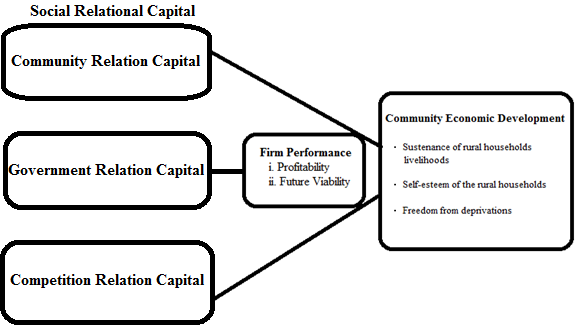
The relationship of firms with external and surrounding social agents and factors is called social-relational capital Cic (2003). These factors and surroundings social agents component consist of the community, the government and the competitor’s relations. Firm relations are a cause of awareness (Nahapiet and Ghosgal, 1998). In this study, community relation capital, government relation capital and competitor relation capital were taken as the main indicator of social relation capital.
Community Relation Capital
the trust-based relationship of the firm within the same community or outside the community of the same nature, is called community relation capital.
Competitor Relation Capital
now a day’s marketing plays a vital role in the performance of firms as well in the development of the business community. The demand for handloom products increases due to its marketing, such as packing, price etc.
Government Relation Capital
according to Cic (2003), in regulating firms, the government agencies collaborate an immense role. Hence trust and interaction with institutions and other government agencies were taken as a measure in this research study.
Data and Methodology
Primary data is used in this research for analysis. A well-designed questionnaire was
used for the collection of primary data via direct investigation methods. . data was collected from the household; hence an eligibility criterion was developed, and the household was shortlisted for provision of information’s.
Sampled Community
The weavers at handlooms community produce the same production use unique methods of production with common goals.
Table 1. Variability
| Variables width="246">Definitions width="114">Sources width="72">Symbol | > Community Economic Development width="246">It was measured as a weighted index generated by Emmanuel o. Manyasa, in his research study, titled social capital and rural economic development. The weighted index comprised measures of sustenance, freedom and self-esteem of members of the community.>Devi = 0.4*(Susi) + 0.7(Semi) +0.8(Frmi) width="114">Emmanuel o. Manyasa (2009) width="72">CED | > Social Relational Capital width="246">The association with external factors of the firm is known as social-relational capital. width="114">Cic (2003) width="72">SRC | > Community Relation Capital width="246">The trust within community members and outside of the communities is known used as a measure of community relational capital. width="114">Cic (2003) width="72">CnRC | > Competitor Relation Capital width="246">The associations of the firm with other competitive agents of the community are measured as competitor relational capital. width="114">Cic (2003) width="72">CmRC | > Government Relation Capital width="246">The association of firms with government agencies is used as a measure of government relational capital. width="114">Cic (2003) width="72">GRC |
To analyze the impact of relational capital on the community economic development, the following given regression model is modified from the work of Kijek (2008) and Cic (2003).
CED = ? + ?1 CRC + ?2 SRC + ?3 INC + ?-------------------------------------------1
Where CED= Community Economic Development
CRC= Customer Relation Capital
SRC= Supplier Relation Capital
INC= Internal Network Capital
? = Error term
Pilot Study
Pre-test of the variability and model was undertaken prior to the full study. The research
was made reliable by applying the factor analysis, whereas the reliability of the research
Instrument was made more reliable.
Factor Analysis
Different methods, such as Principal component analysis and Varimax rotation, were used to extract the factors. The findings of the extract factors that measure social-relational capital are as follows:
Table 2. Rotated Component Matrix of Social Relation Capital
| S. No width="66">Items width="54">Mean width="53">Std. Dev width="85">Item reliability width="72">Factor loading width="84">Composite Reliability width="78">Average Composite Extraction | > 1. width="66">CPRC1 width="54">.60 width="53">.207 width="85">0.779 width="72">0.606841 width="84" rowspan="3">align="center">0.67 width="78" rowspan="3">align="center">0.62 | > 2. width="66">CPRC2 width="54">.62 width="53">.204 width="85">0.84 width="72">0.7056 | > 3. width="66">CPRC3 width="54">.64 width="53">.192 width="85">0.81 width="72">0.6561 | > 4. width="66">CMRC1 width="54">.65 width="53">.200 width="85">.727 width="72">0.528529 width="84" rowspan="4">0.73 width="78" rowspan="4">0.5623 | > 5. width="66">CMRC2 width="54">.62 width="53">.210 width="85">.732 width="72">0.535824 | > 6. width="66">CMRC3 width="54">.65 width="53">.188 width="85">.771 width="72">0.594441 | > 7. width="66">CMRC4 width="54">.62 width="53">.228 width="85">.760 width="72">0.5776 | > 8. width="66">GRC1 width="54">.62 width="53">.221 width="85">0.736 width="72">0.541696 width="84" rowspan="4">align="center">0.781 align="center"> width="78" rowspan="4">align="center">0.6443 align="center"> | > 9. width="66">GRC2 width="54">.63 width="53">.211 width="85">0.795 width="72">0.632025 | > 10. width="66">GRC3 width="54">.63 width="53">.224 width="85">0.799 width="72">0.638401 | > 11. width="66">GRC4 width="54">.62 width="53">.223 width="85">0.814 width="72">0.662596 |
Source: Primary Data
Social relation capital component was checked with factor analysis. The competitor relation capital was valid with the highest loading value of 0.70 (table-1). This was the 2nd item known as CpRC2, which described the role of marketing and advertisement of the product in the growth and profitability of the weaver business (Annex-A, table-1). The second highest loaded was the 10th item known as government relation capital GRC4. The GRC4 opt for the role of government for the growth and profitability of the weaver business (Annex-A, table-1). GRC4 was loaded with a high load value of 0.660. The CpRC1 was loaded with a value of 0.606 (table-6.2). CpRC1 was meant that weavers power and reputation as a business community in competition with other related business community. The high power and strength of the firms indicated the power to face lobbies and related challenges within the market, while the weak and low reputed community always step toward downward accelerations (Annex-A, table-1). CpRC3 was loaded with 0.65 (table-1). CpRC3 was meant that the power of other competitors and communities was an important indicator to be analyzed for future viability and competition; similarly, the role-playing by the general public in the process of production was also loaded to be valid for measurement of competition relation capital (Annex-A, table-1).
The 4th item loaded was CmRC1, which stand for community relation capital. CmRC1 was loaded with a value of 0.52 (table-6.2); CmRC1 depict wither the weavers tends toward community management. A good community always motivates empowerment toward social and economic problems to face to the community enterprises as a whole, while commitment toward community exertion meant low empowerment to the decision-making process (Annex-A, table-1). The 5th item loaded was CmCR2, which was computed with a load value of 0.53 (table-6.2). This meant the relationship of the weavers with other community of the same nature. Good relationship Of any enterprise communities hereby enhance each other performance by the exchange of different ideas and information’s while weak relationship separate and deprive the energy of the community of growth and enhancement, comparatively. Similarly, CmCR3 was hereby loaded with a high and valid value of 0.59 (table-6.2). CmCR3 was meant the trust between cluster community members with other communities (Annex-A, table-1). The 7th item (CmCR4) was loaded with a high value of 0.57 (table-1). CmCR4 was meant the commitment and contribution of weavers toward their community development. Heightened commitment and value to the community meant a step toward community empowerment and development, while a low level of commitment and contribution was considered a step toward a low rate of community development and empowerment (Annex-A, table-1).
Computed the other items were about government relation capital (GRC). The 8th item was hereby weighted with a load value of 0.54 (table-6.2). GRC1 was about the acceleration of lobbies of the weaver on the support of government to face the international firm in the market Weavers face Chinese competition since 2010, the role of government to face such competition was indexes to measure government relation capital. A positive role by the government meant strong GRC, while the absence of government lobbies meant weak GRC (Annex-A, table-1). The 9th item loaded was GRC2 which was computed with a high value of 0.62 (table-6.2). GRC2 was about the credit and service support of the government on the community (Annex-A, table-1). Item GRC3 was about provisions of different services by the government to the enterprise community (Annex-A, table-1). GRC3 was loaded with a value of 0.63 (table-6.2).
Regression Analysis
A linear and significant relationship was determined between social-relational capital components such as community relation capital and government relation capital with community economic development. The results also show an insignificant effect of competition relation capital on community economic development (Table-3).
Table 3. Regressions.
| Dev width="84">Coef. width="78">Std. Err. width="60">T width="72">P>|t| width="174">95% Conf. Interval | > CMRC width="84">.4397099 width="78">.1069549 width="60">4.11 width="72">0.000 width="174">.2285332 .6508865 | > GRC width="84">.3909077 width="78">.1016799 width="60">3.84 width="72">0.000 width="174">.1901463 .5916692 | > CPRC width="84">.1620455 width="78">.0994676 width="60">1.63 width="72">0.105 width="174">-.0343478 .3584388 | > Cons width="84">.0658769 width="78">.054001 width="60">1.22 width="72">0.224 width="174">-.0407451 .1724989 |
Overall, the regression model indicates that social-relational capital has great influence and accelerates 46.17% of the observed variance in the development of the business community (Annex- B)
Multicollinearity:
The variant inflated test was used in order to check the existence of Multicollinearity as follows:
Variant Inflated Factor Test
Results of the variant inflated factor test are as follows.
Table 4. Variant Inflated Factor Test.
| Variable width="156">VIF width="197">1/VIF | > GRC width="156">2.21 width="197">210.452457 | > CMRC width="156">1.97 width="197">0.508649 | > CPRC width="156">1.89 width="197">0.528770 | > Mean VIF width="156">2.02 width="197">
|
The results show that there is no chance of a Multicolinearity problem in the data used because the value VIF is less than 10.
Heteroscedasticity
To check the Heteroscedasticity in the model, the following tests are used.
HO: Data is Homoscedastic
H1: Data is Heteroscedasticity
The following two tests are used.
Breusch-Pagan / Cook-Weisberg test for Heteroscedasticity
The Breusch-Pagan test is designed to detect any linear form of Heteroscedasticity.
Chi2(1) = 39.01
Prob>Chi2 = 0.0000
The high value of chi-square > 4 indicates the presence of Heteroscedasticity in the model.
The value of chi2 (1) is (39.01) is more than four. It hereby suggests that there is a Heteroscedasticity problem in the data. The following test is also used to detect Heteroscedasticity.
White's and Cameron &Trivedi's decomposition of IM-test
Table 5. Cameron &Trivedi's decomposition of IM-test.
| Source width="114">Chi2 width="126">Df width="147">P | > Heteroscedasticity width="114">5.23 width="126">9 width="147">0.8138 | > Skewness width="114">3.72 width="126">3 width="147">0.2929 | > Kurtosis width="114">1.04 width="126">1 width="147">0.3078 | > Total width="114">621.82 width="126">08 width="147">0.6945 |
Resultantly the Heteroscedasticity has been detected here in the model.
Remedial Measures
To remedy the situation, the robust options was used (table-6.21) to relax the assumption of Heteroscedasticity. The results of the Robust regression are as follows:
Table 6. Robust Regression.
| CEDev width="75">Coef. width="78">Std. Err. width="66">T width="78">P>|t| width="174">[95% Conf. Interval | > CMRC width="75">4397099 width="78">.1169606 width="66">3.76 width="78">0.000 width="174">.2087775 .6706422 | > GRC width="75">.3909077 width="78">.0807386 width="66">4.84 width="78">0.000 width="174">.2314938 .5503217 | > CPRC width="75">.1620455 width="78">.0897655 width="66">1.81 width="78">0.073 width="174">-.0151916 .3392825 | > Cons width="75">.0658769 width="78">.0465223 width="66">1.42 width="78">0.159 width="174">-.0259788 .1577326 | > n= 169, F( 3, 165) = 71.04, Prob> F= 0.00, R-squared = 0.4713, Root MSE = .15294 | |||||
The results show that F-ratio is highly significant, which indicates that the model overall is a good fit. Interestingly after relaxing the problem of Heteroscedasticity, the components of social relation capital, including competition relation capital, become significant (table-6.21). The coefficient of determinations (R2 ) =0.4713, which means 47.13% variation in community development (dependent variable), was explained by the independent explanatory variables included in the model (Annex-E). The explanatory variables showed significant positive effects on the business community.
Social Relational Capital in Community Economic Development
The findings on this objective showed a significance and positive relationship between Social Relation Capital and Community economic development.
Findings from the study revealed that community economic development is positively and significantly influenced by community/social responsibility. This means that handloom firms that are associating with the community had great experience of new design and ideas about their products and experiences a high interest in community development activities. The results are followed by McGuire et al. (1998).
Further too, there exists a significant relationship between government relational capital and community economic development. The impact is positive, followed by Rajan & Zungales (2000).
However, the social-relational capital findings revealed that competitor relational capital has no effect on Community economic development. This is because the business is limit to the internal community members and the experience of the firm toward outside elements was nil. Due to no serious attention of the firms toward competitors badly collapsed their performances hence failed to benchmark on them and some were being pushed out of the industry in a way that they were selling off their firms to others which put their future viability was in doubt.
Roberts & Dowling (2002) had the same results who argued that the latent quality of products is improved and catch higher prices by the value of reputation in differentiating products/services.
The overall results indicate that relational capital, such as community and government relation capita, significantly affect community economic development. However, the relational competition capital had no effect on community economic development.
Annex Table 1. Specifications of Social Relational Capital Sub-Variables.
| S.No width="65" valign="top">Items width="399" valign="top">Observations required | > 1 width="65" valign="top">CpRC1 width="399" valign="top">We are a reputable organized community compared to outside competitors with the power to make immediate changes in the production accordingly. | > 2 width="65" valign="top">CpRC2 width="399" valign="top">Marketing play vital role in competition | > 3 width="65" valign="top">CpRC3 width="399" valign="top">Our cluster enterprises recognizes the value of competitors & general public for positive business reputation | > 4 width="65" valign="top">CmRC1 width="399" valign="top">We are a good enterprise community | > 5 width="65" valign="top">CmRC2 width="399" valign="top">Our relationship with other community is good/relationship with other community affect business? | > 6 width="65" valign="top">CmRC3 width="399" valign="top">We normally share business ideas with other community members | > 7 width="65" valign="top">CmRC4 width="399" valign="top">Our cluster provide its part to community development | > 8 width="65" valign="top">GRC1 width="399" valign="top">The government has helped out our enterprises to compete Chinese imports | > 9 width="65" valign="top">GRC2 width="399" valign="top">Government credit and other services support has impact on business profit and community | > 10 width="65" valign="top">GRC3 width="399" valign="top">As an enterprise community we are satisfied from the government | > 11 width="65" valign="top">GRC4 width="399" valign="top">Government role is important for profitability |
Table 2. CEDeve and SRC
| Source width="176">SS width="126">Df width="148">MS | > Model width="176">3.44011017 width="126">3 width="148">1.44305566 | > Residual width="176">3.85948659 width="126">165 width="148">.023390828 | > Total width="176">7.29959676 width="126">168 width="148">.043449981 | > n=169, F( 3, 165)=49.02, Prob> F=0.00 (sig), Adj R-squared=0.4617, Root MSE=.15294 | |||
References
- Adelman, I. (1961). Theories of Economic Growth and Development, Calif, Stanford University Press.
- Amini, A. (2004). The distributional role of small business in development, International Journal of Social Economics, Vol. 31 No.
- Ansari, R.R. (1984). A Study of Marketing problems of Powerloom Industry in Malegaon Cityof Nasik District, Unpublished M.Phil dissertation, Nagpur University, Nagpudr.
- Arasaratnam, S. (1990). Weavers Merchants and Company: The Handloom Industry in South Eastern India, 1750 - 1790 in S. Subramanyam (Ed.) Merchants, Markets andthe State in Early Modern India, Delhi: Oxford University Press
- Arrow, K. (1974). The Limits of Organization, New York, W. W. Norton.
- Arrow, K. and G. Debreu. (1954). Existence of Equilibrium for a Competitive Economy, Econometrica, Vol. 22, 265-290.
- Baker, W. (2000). Achieving Success through Social Capital. Jossey-Bass Inc.
- Barr, A. (2003). Trust and Expected Trustworthiness: Experimental Evidence from Zimbabwean Villages, The Economic Journal, Vol. 27, 59-66.
- Basirat Baygi, M. Hashemkhani Zolfani, S. Rezaeiniya, N. & Aghdaie, M. H. (2011). Using Fuzzy AHP to Develop Intellectual Capital Evaluation Model in Hotel Industry.European Journal of Scientific Research, 59(2), 170-178.
- Cooke, Philip, and Morgan, K. (2000). The associational economy; firms, regions, and innovation. Oxford, Oxford University Press.
- Cousins, P. D. Handfield, R. B. Lawson, B. & Petersen, K. J. (2006). Creating supply chain relational capital: the impact of formal and informal socialization processes. Journal of Operations Management, 24(6), 851-863.
- De. Tocqueville. Alexis , (1835). Democracy in America.Reprint (1998). Ed. Patrick Ranshaw, trans, Henry Reeve, Garden City, NY: Doubleday.
- Dolle, B.M. (1992). A study of Socio Economic Problems of Power loom industry in Malegaon, Unpublished Ph.D. thesis. University of Pune, Pune
- Easterlin, R. (1981). Why Isn't the Whole World Developed? Journal of Economic History, Vol. 41, 1-20.
- Easterly, W. and R. Levine (1997), Africa's Growth Tragedy: Politics and Ethnic Divisions, Quarterly Journal of Economics, Vol. 112, 1203-1250.
- Edwards, W. (2004).Interpreting financial performance measures. Journal of Business Finance & Accounting, 23-56
- Fei, J. C. and Ranis, G. (1969). Economic Development in Historical Perspective, American Economic Review, Vol. 59, 386-400.
- Fibercopia (2007). The Khaddi and village base business, World Press. 2007-10- 04/khadi.
- Fine, and Ben. (1998). From Bourdieu to Becker: Economics Confronts the Social Sciences. International Papers in Political Economy 5(3):1-43.
- Grootaert, Christiaan., and Narayan., D. (2000). Local Institutions, Poverty, and Household Welfare in Bolivia, Local Level Institutions Working Paper 9, Social Development Department, World Bank, Washington, D.C
- Grootaert, Christiaan., Oh, G.T., and Swamy., A. (1999). Social Capital and Development Outcomes in Burkina Faso, Local Level Institutions Working Paper 7, Social Development Department, World Bank, Washington, D.C.
- Hamilton, and William (1999). How Suburban Design Is Failing Teen-Agers. New York Times, May 6, p. F1.
- Harriss, John., and Renzio., P. D. (1997). Missing Link or Analytically Missing? The Concept of Social Capital, Journal of International Development 9(7):919-37.
- M. and J. E. Stiglitz (eds.), Frontiers of Development Economics: The Future in Perspective, New York, Oxford University Press, 13-50.
- Miller, and Roberta (1997). Healthy Boston and Social Capital: Application, Dynamics, and Limitations, National Civic Review 86(2):157-66.
- Moore, L., Francis., and Paul Martin D.B. (1997). Building Social Capital without Looking Backward, National Civic Review 86(2):119-28.
- Morgan, K. (1997). The learning region: institutions, innovation and regional renewal, Regional Studies, 31(5), 491-503.
- Nadvi, K. (1999b). Shifting ties: Social network in the surgical instrument cluster of Sialkot, Pakistan', Development and Change, 30, pp141-175.
- Nam, V. H., Sonobe, T., & Otsuka, K. (2010). An Inquiry into the development process of village industries: The case of a knitwear cluster in Northern Vietnam, Journal of Development
- OSLO Manual.(2005). Organization for Economic Co-Operation and Development (OECD), Guideline for collecting and interpreting innovation Data, 3rd Edition. [14]. IMF, International Monetary Fund (2008).
- Pantoja, E. (2000). Exploring the Concept of Social Capital and its Relevance to Community-Based Development: The Case of Coal Mining Areas of Orissa, India, Social Capital Initiative: Working Paper No. 18, World Bank.
- Pollitt, and Katha., (1996). For Whom the Ball Rolls. Nation, April 15, p. 9
- Porter, and Michael. (2000). Location, competition and economic development; local clusters in a global economy.Economic development quarterly 14:15-34, No. 1.
- Smith, A. (1776). An Inquiry into the Nature and Causes of the Wealth of Nations, , accessed on 15.05.2007.
- Smith, M. K. (2001). Social Capital, The Encyclopedia of Informal Education, , accessed on 20.05.2007.
- Woolcock, M. (1998). Social Capital and Economic Development: Toward a Theoretical Synthesis, Theory and Society, Vol. 27, 151-208.
- World Bank. (1998). The initiative on defining, monitoring and measuring social capital; overview and program description. Washington, D. C., World Bank, Social Development Family
- World Bank. (2004). Indigenous Knowledge: Local Pathways to Global Development. African region: World Bank
- Yusuff R. M. (2004). Manufacturing best practices of the electric and electronic firms in Malaysia.Benchmarking: An International Journal, 11(4), 361- 369.doi:10.1108/14635770410546764,
Cite this article
-
APA : Rahman, M. U., Malik, M. F., & Ahmad, W. (2019). Social Relational Capital as a Community Economic Development Factor. Global Economics Review, IV(I), 108-119. https://doi.org/10.31703/ger.2019(IV-I).11
-
CHICAGO : Rahman, Mujib Ur, Muhammad Faizan Malik, and Wisal Ahmad. 2019. "Social Relational Capital as a Community Economic Development Factor." Global Economics Review, IV (I): 108-119 doi: 10.31703/ger.2019(IV-I).11
-
HARVARD : RAHMAN, M. U., MALIK, M. F. & AHMAD, W. 2019. Social Relational Capital as a Community Economic Development Factor. Global Economics Review, IV, 108-119.
-
MHRA : Rahman, Mujib Ur, Muhammad Faizan Malik, and Wisal Ahmad. 2019. "Social Relational Capital as a Community Economic Development Factor." Global Economics Review, IV: 108-119
-
MLA : Rahman, Mujib Ur, Muhammad Faizan Malik, and Wisal Ahmad. "Social Relational Capital as a Community Economic Development Factor." Global Economics Review, IV.I (2019): 108-119 Print.
-
OXFORD : Rahman, Mujib Ur, Malik, Muhammad Faizan, and Ahmad, Wisal (2019), "Social Relational Capital as a Community Economic Development Factor", Global Economics Review, IV (I), 108-119
-
TURABIAN : Rahman, Mujib Ur, Muhammad Faizan Malik, and Wisal Ahmad. "Social Relational Capital as a Community Economic Development Factor." Global Economics Review IV, no. I (2019): 108-119. https://doi.org/10.31703/ger.2019(IV-I).11