
- Addae-Korankye, A., & Aryee, B. A. (2021). The relationship between strategic management practices and the growth of Small and Medium Enterprises (SMEs) in Ghana. Business: Theory and Practice, 22(1), 222-230.
- Agwu, M. E. (2018). Analysis of the impact of strategic management on the business performance of SMEs in Nigeria. Academy of Strategic Management Journal, 17(1), 1-20.
- Agwu, M. O., & Emeti, C. I. (2014). Issues, challenges and prospects of small and medium scale enterprises (SMEs) in Port-Harcourt city. European Journal of Sustainable Development, 3(1), 101- 114.
- Ahmad, I., & Ahmad, S. B. (2021). Effect of Managerial Skills on the Performance of Small-and Medium- Sized Enterprises: A Case Study in Pakistan. The Journal of Asian Finance, Economics and Business, 8(4), 161-170.
- Ali Qalati, S., Li, W., Ahmed, N., Ali Mirani, M., & Khan, A. (2021). Examining the factors affecting SME performance: the mediating role of social media adoption. Sustainability, 13(1), 75.
- Ali, M., & Qun, W. (2019). Strategic Management Practices and Performance of the SMEs in Bangladesh. International Journal of Advanced Research, 7(1), 69-78. DOI:10.21474/IJAR01/8298
- Allen, R. S., & Helms, M. M. (2006). Linking strategic practices and organizational performance to Porter's generic strategies. Business process management journal, 12(4), 433-454. DOI:10.1108/14637150610678069
- Avram, D. O., & Kühne, S. (2008). Implementing responsible business behavior from a strategic management perspective: Developing a framework for Austrian SMEs. Journal of business ethics, 82(2), 463-475.
- Beaver, G., & Prince, C. (2004). Management, strategy and policy in the UK small business sector: a critical review. Journal of small business and enterprise development, 11(1), 34-49. DOI:10.1108/14626000410519083
- Bell, E., Bryman, A., & Harley, B. (2011). Business research methods. Oxford university press.
- Bilal, M., Fatima, S., Ishtiaq, M., & Azeem, H. M. (2020). Factors affecting the choice of Islamic banking by SMEs in Pakistan: Implications for Islamic banks' corporate governance. Pakistan Journal of Commerce and Social Sciences (PJCSS), 14(1), 255-272.
- Dar, M. S., Ahmed, S., & Raziq, A. (2017). Small and medium-sized enterprises in Pakistan: Definition and critical issues. Pakistan Business Review, 19(1), 46-70.
- Forth, J., & Bryson, A. (2019). Management practices and SME performance. Scottish Journal of Political Economy, 66(4), 527-558.
- Gujarati, D. N., Porter, D. C., & Gunasekar, S. (2012). Basic econometrics. Tata McGraw-Hill Education.
- Gure, A. K., & Karugu, J. (2018). Strategic management practices and performance of small and micro enterprises in Nairobi City County, Kenya. International Academic Journal of Human Resource and Business Administration, 3(1), 1-26.
- Herrmann, T., Brandt-Herrmann, G., & Jahnke, I. (2007). Work process- oriented introduction of knowledge management: reconsidering the guidelines for SME. In Proceedings of I-Know (pp. 136-143).
- Karadag, H. (2015). Financial management challenges in small and medium-sized enterprises: A strategic management approach. EMAJ: Emerging Markets Journal, 5(1), 26-40.
- Khalique, M., Isa, A. H. B. M., & Nassir Shaari, J. A. (2011). Challenges for Pakistani SMEs in a knowledge- based economy. Indus Journal of Management & Social Sciences, 5(2), 74-80.
- Khan, A. J., Tufail, S., & Ali, A. (2021). Factors Affecting Performance of Small & Medium Enterprises: The Mediating Role of Knowledge Management. Pakistan Journal of Humanities and Social Sciences, 9(2), 197-209.
- Kitching, J. (2000). Human Resource Management Policies anti Practices in SMEs in the UK: Does it Really Influence Their Performance? International Small Business Journal, 18(2), 101.
- Omsa, S., Ridwan, M., & Jayadi, M. (2017). The Effect of Strategic Management Practices on SME Performances in Makassar, Indonesia. American Journal of Theoretical and Applied Business, 3(4), 71-80. DOI:10.11648/j.ajtab.20170304.12
- Orser, B. J., Hogarth-Scott, S., & Riding, A. L. (2000). Performance, firm size, and management problem solving. Journal of small business management, 38(4), 42-58.
- Saunders, M., Lewis, P. H. I. L. I. P., & Thornhill, A. D. R. I. A. N. (2007). Research methods. Business Students 4th edition Pearson Education Limited, England.
- Schraeder, M. (2002). A simplified approach to strategic planning: Practical considerations and an illustrated example. Business process management journal, 8(1),8-18
- Selvam, M., Gayathri, J., Vasanth, V., Lingaraja, K., & Marxiaoli, S. (2016). Determinants of firm performance: A subjective model. International Journal of Social Science Studies, 4(7), 90. DOI:10.11114/ijsss.v4i7.1662.
- Sensini, L., & Vazquez, M. (2021). Effects of Working Capital Management on SME Profitability: Evidence from an emergent economy. International Journal of Business and Management, 16(4), 85-95
- Tabachnick, B. G., Fidell, L. S., & Ullman, J. B. (2007). Using multivariate statistics (Vol. 5, pp. 481-498). Boston, MA: Pearson
- Walter, J., Kellermanns, F. W., Floyd, S. W., Veiga, J. F., & Matherne, C. (2013). Strategic alignment: A missing link in the relationship between strategic consensus and organizational performance. Strategic Organization, 11(3), 304-328.
- Wang, C., Walker, E., & Redmond, J. (2007). Explaining the lack of strategic planning in SMEs: The importance of owner motivation.
Abstract:
Small and Medium Enterprises (SMEs) in Pakistan are playing a significant role in the economic development, and performance of these SMEs is very crucial to the country. Therefore, the aim of current research is to check the significance of strategic management practices in the SMEs operating in the South Panjab of Pakistan. Three variables were created from the existing literature (strategy development, strategy implementation, and strategy evaluation). Convenient sampling has been used to collect primary data through self-administrative questionnaires. By exercising different Inferential Statistical Techniques, this paper has found a significant link between all the strategic management functions and business performance of selected SMEs in the South Punjab of Pakistan. For this purpose, IBM SPSS Statistics software has been applied. This research has recommended that owners as well as management of SMEs should regularly evaluate and take corrective measures on schedule and the progress of various strategies.
Key Words:
Strategic Management, Small and Medium Enterprises, Business Performance
Introduction
SMEs are strengthening to progress in a number of ways; the production of jobs to expand the workforce, providing much-needed adaptability and economic creativity, boosting exports, and contributing to an improvement in GDP value addition. The government has assessed that more knowledge and practical measures are needed to make full use of the potential of the SME industry and lead it to a growth progression. For this reason, the central bank of Pakistan has asked its scheduled banks to formulate an effective plan of action for the growth of SMEs in Pakistan (Ali Qalati et al., 2021). This is the result of SBP's implication that strong institutions are a requirement for a productive SME industry that also includes a stable industry system that could deliver the support needed to make it simple for SMEs to attain economic comfort and efficiency. A stable SME industry will also smooth the process of inherent, reducing the long-term need for costly imports and boosting the economy (Forth & Bryson, 2019). In addition, SBP has also set a goal to increase SME’s financial inclusion by 2020 to allow the industry to experience substantial progress and advancement (Dar, Ahmed & Raziq, 2017)
It is not the first time that the SME sector has caught more attention from the government, as in the previous regime, it was very much there (Ali Qalati et al., 2021). Yes, it is an integral part of the 2025 dream. Experts stressed SME as a game-changer for the country's economic uplift. It can alleviate poverty and create jobs. During this time, however, the absence of a quantum leap in our SME sector is a testament to the fact that SME growth has remained more rhetorical than a key element of an economic reform agenda (Khalique, Shaari, & Abdul, 2011). The arrival of global tech-based market players such as Uber, Careem, Food-panda, Daraz, and Amazon has also made the business environment of different SMEs more competitive in the developing world.
However, better strategic management practices offer new tools for small firms to succeed, expand and retain the competitive advantage of sustainable development (Ali & Qun, 2019). Strategic planning is being used in protecting future market hazards in securing the future of vulnerable sectors of industry in the form of small and medium enterprises. Agwu (2018) suggests that SMEs are helped to look forward to these circumstances and be skeptical. He further states that SMEs are engaging in the strategic formulation have witnessed more growth in sales, high capital returns, better profitability margins, superior growth of staff, global business enhancement, and there are few chances of failure in the business arena (Omsa, Ridwan & Jayadi, 2017). Organizational structure is offered by strategic planning that enables a firm to benefit from market advantages and increased market performance (Agwu, 2018). Management and ownership must help SMEs to thrive and maintain their businesses to follow greater strategic management practices (Gure & Karugu, 2018).
Strategic management includes designing a strategic mission, goal setting, evaluating the situation, designing a strategy, applying the strategy, and evaluating it. The system is complex and continuous; single component change can require a alter the overall process (Forth & Bryson, 2019). Strategy design includes consideration of financial, cultural, political, technical, ecological, and industrial environmental factors, including barriers to entry, market competition, alternative availability, and buyer and supplier bargaining power (Ali & Qun, 2019). Implementing strategy in practice is about ensuring that identified strategies are actually implemented by designing Impactful strategies organizational structure to promote good performance, resource policies in the different plus extents and organizing change (Orser, Hogarth-Scott & Riding, 2000).
As theoretical and empirical evidence shows, Strategic management practices introduced by a business have an impact on performance. Strategic management practices have improved strategic productivity and strategic positioning on a variety of political and societal issues. Firms can improve their market share substantially by enhancing their revenue statement and increasing their customer base by effectively implementing strategic management practices (Ali & Qun, 2019). However, there is limited research work available in the Pakistani context to explore fully the relationship of different SME management practices and business performance. Therefore, it is a valuable addition to the current body of literature having a focus on the effectiveness of strategic management practices in SMEs. For this purpose, this study has the following objectives:
• To explore the effectiveness of strategy formulation in selected SMEs.
• To examine the effectiveness of strategy implementation in selected SMEs.
• To analyze the effectiveness of strategy evaluation in selected SMEs.
The current research intends to support various audiences, including executives and entrepreneurs from small and medium-sized businesses, the Government of Pakistan, and research scholars. The current study intends to help the owners and management in formulating better approaches to deal with the different internal as well as external challenges and sustainable growth for the business resulting in a positive impact on the whole economy.
Literature Review
SMEs are non-auxiliary, autonomous business units that employ less than 250 people in Pakistan or have revenue of up and about Rs.250 million per year and paid-up assets of up to Rs.25 million. SBP defines SMEs as any business concern in the specific fiscal year engaged in the manufacture, trade, or service of current net revenue of three hundred million rupees. Certain companies have an aggregate capital of one hundred million rupees with a minimum of fifty employees with aggregate assets worth Fifty million rupees or less, not including land and buildings. In Pakistan, there was no formal and consistent concept of small and medium-sized industries, which allowed SMEs to grow and thrive (Bilal et al., 2020). Pakistan's government and political regimes have not defined a unified definition for SME's. A harmonized concept that takes account of the micro, small, medium, and large enterprises can help to establish a sound SME growth process (Ahmad & Ahmad, 2021).
Therefore, bearing in mind that the proposed definition is understood below as a practitioner and academic who is expected to benefit the economy of Pakistan and is also recognized internationally. The idea of a small business is an autonomous and controlled enterprise, limited in size and revenue depending on the market. An illustration of a small business is a small bakery with ten employees. In the nation's economy, SMEs play an important role. Their position is very critical in terms of production, job creation, export contribution, and promoting a fair distribution of income. This business strategy targets the resources of an organization to join or expand into a small market or business market (Agwu & Emeti, 2014). Typically, where the organization knows the customers and has goods that suit its needs, a focused approach is used. The emphasis approach is one of three general advertising techniques. See the strategy for differentiation and the two other low-cost strategies.
The aim and strategy for the market include market differentiation and targeting one or more customer classes or corporate customers. Successful businesses have strategic advantages in achieving high-performance levels. By distinguishing themselves from their competitors or from the main market segments on which their efforts are concentrated, they can gain market shares in general (Allen & Helms, 2006). The objective approach determines where the company can compete effectively in market segments. To focus on the firm's resources, the approach combines the properties of products with a competitive advantage for the company, which will probably lead to more sales, profits, and revenues. The low production cost is a significant market advantage but does not extend to all sectors. The goal is to divide the industry into price and cost-sensitive markets.
Strategy can be categorized as a lasting approach to achieving corporate objectives (Beaver & Prince, 2004). It exists as the design or strategy that participate in the core purposes, objectives, and scheme of action of a single group in its totality (Schraeder, 2002). Strategy is also described as an action plan detailing how a firm can achieve its continuing goal. Continuous, forward-looking, detailed, systematic, and primarily linked management level which describes the traditions of your organization is strategic management. According to Avram & Kühne (2008), it is a continuous procedure that identifies and monitors the business and markets where the enterprise is indulged, analyses its rivals, and sets objectives and priorities to resolve recent and future challenges.
Wang, Walker & Redmond (2007) have mentioned that the strategy examines each year again to see whether it has been implemented and whether the new strategy to change circumstances, new technologies, new competition, new business conditions, or the new social, economic, or organizational framework has changed or has to be replaced. It examines each strategy annually. Whether SMEs execute strategic management defines the strategic management practices of the business. Managers have started to consider that an organization is efficient when it is using a minimum of resources (efficiency) to achieve its objectives (effectiveness) (Wang, Walker & Redmond (2007). Therefore, some specific organizational principles endorsed an organization's concept of achieving its performance targets are based on resource constraints (Beaver & Prince, 2004).
Ali & Qun (2019) have described the perceived firm performance as the successes of a firm in relation to some of the standards. We consider perceived production quality such as quantified targets or profitability. The quality of the firm is characterized as actions and also results. The definition includes the attainment of desired objectives and the setting and evaluation of objectives. However, the underlying idea for this research is to explore this engagement, given because if the management behavior is correct, expected performance rates (success) and vice versa will be achieved. Progress and failure are considered the two sides of the series of successes (Gure & Karugu, 2018). Organizational perceived performance involves an organization's actual output or output calculated against its expected yields (Forth & Bryson, 2019). While the interpretations can vary among the researchers, they agree that the company's perceived achievement is to produce superior performance and/or goals. There exist different levels of organizational success, including profitability, market efficiency, and organizational effectiveness, though neither was later referred to as perceived firm performance (Ali Qalati et al., 2021).
The business manager or owner's center of the thought is overall better strategy adherence to have better resource allocation and performance. The firms’ actual performance varies depending on the effectiveness of the management of the three layers, such as top, middle, and bottom level management (Kitching, 2000). Comprehensive success provides important feedback for check and balance, enhancing, maximizing efficiency, rewarding, disciplinary, and a corporate objective alignment system. Some of the structures recommended by several academics to achieve company performance are profitability, efficiency, balance sheets, economic value-added, activity-based evaluation, and customer satisfaction (Khan, Tufail & Ali, 2021). When assessing the performance metrics and ranking of SMEs, they use only financial indicators that include profitability, liquidity, and capital return, and debt level (Sensini & Vazquez, 2021). Nevertheless, the performance of the firm can be measured through different ways, such as financial indicators, market penetration, customer satisfaction, operational quality, employees’ motivation, and commitment (Selvam et al., 2016).
Karadag (2015) has conducted a study on different issues of financial management in Turkish SMEs based on a strategic management approach. He has highlighted that the effective use of the acquired financial resources, including an efficient cash management system, has valuable importance for the long-term survival and growth of selected SMEs. He has analyzed some important practices of strategic financial management practices regarding financial planning, asset management, financial reporting, and control. Furthermore, his study also examined to what extent the implementation of these practices helps to better performance results. Ali & Qun (2019) has examined the impact of strategic management practices on the performance of Bangladeshi SMEs. They have taken data regarding different strategic management functions and have found a significant relationship with the performance of selected small and medium business units in Bangladesh. Their research has suggested that the adoption of a strategic management process is very important for business success, and top-level as well as lower-level management should be part of the entire process for the long-term success of the business firms.
Agwu (2018) has investigated the impact of strategic management practices on the business performances of SMEs in Nigeria, and for this purpose, he collected primary data through questionnaires from the owners of SMEs in Nigeria. His research has tested the study hypotheses by applying different Statistical methods and procedures. A significant connection between strategic management practices and firm performance has been identified. Earlier to it, (Omsa, Ridwan & Jayadi, 2017) have examined the effectiveness of strategic management practices in Indonesian SME firms. Their study has undertaken quantitative research with primary data analysis. They have identified that strategic management practices such as strategic planning, strategic execution, and strategic evaluation have a significant positive impact on different profitability indicators. Similarly, (Gure & Karugu, 2018) have also conducted a study on the relationship between strategic management practices and the performance of SMEs in Kenya. They have collected primary data with the help of a semi-structured questionnaire and have found a significant relationship between independent and dependent variables.
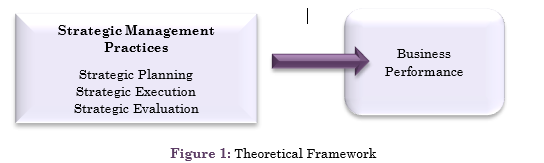
The research has established several hypotheses based on previous literature. The below are the study's hypotheses:
H1: A relationship exists between the formulation of strategy and the output of SMEs.
H2: A relationship exists between the execution of the strategy and the quality of SMEs.
H3: A relationship exists between the assessment strategy and the performance of SMEs.
Research Methodology
The study population has been made up of all SMEs in Pakistan's South Punjab region. Southern Punjab is the area where most of the Saraiki speakers are found in the western and southern areas of Punjab. The geographical range generally includes the divisions of Bahawalpur, Dera Ghazi Khan, Multan and Sargodha (all in the province of Punjab), Dera Ismail Khan (in Khyber Pakhtunkhwa), and Jhang (also in Punjab). The southern Punjab province will consist of three divisions, Multan, Bahawalpur, Dera Ghazi Khan, which will cover 22 districts from a total of Punjab districts. Southern Punjab with a geographical range of over 52 percent of the total area of the province with a population of 32 million, which is much smaller than the rest of Punjab. Official consensus statistics for 2017 count the population of Punjab at 110 million, 32% of whom live in southern Punjab. In this case, we use a convenient sampling technique because of the dispersed and complex nature of our results. In South Punjab, small and medium-sized companies spread from South to North Punjab. The questionnaire was distributed to 400 different business enterprises by adopting self-delivery and collection methods. And we got the answer from the 326 business units. All the items of study variables in the research questionnaire have been adopted from the available relevant literature (Omsa, Ridwan & Jayadi, 2017; Agwu, 2018; Gure & Karugu, 2018; Ali & Qun, 2019). Considering the understanding level of target respondents, the questionnaire was into the Urdu language from English through the National University of Modern Languages (NUML) Faisalabad campus.
This research has undertaken the Pearson correlation (r) analysis to determine the correlation coefficient between the different variables (Fidell and Tabachnick, 2007). The current research has applied the OLS technique to measure the significance of the relationship of dependent and independent variables. In this study, OLS technology was used because it is a well-accepted method and is often used in relevant research (Omsa, Ridwan & Jayadi, 2017; Agwu, 2018; Gure & Karugu, 2018; Ali & Qun, 2019). It is important to mention here that even the assumptions of reliability and multiple linearities, based on data analysis and classification, are successfully considered in this regard. "Calculation or theory precision relates to reliability" (Bell and Bryman, 2011, p.158). The aim of verifying reliability is defined by Cooper and Schindler (2011) as limiting the potential for biased results. Measurement accuracy is checked using an internal quality statistical method that is the alpha of Cronbach (Gujarati, Porter & Gunasekar, 2012). Internal consistency includes correlating the input in the instrument (questionnaire) with each other to questions (scale items). "Either a question subgroup or all the questions in your questionnaire check the reliability of the answers" (Saunders, Lewis & Thornhill, 2007, p.430). Statistical set for Social Sciences (SPSS 20.0) has been applied for data analysis and results.
Results Analysis and Discussion
The study focused on SMEs in the South Punjab region of Pakistan. The questionnaires were distributed, and follow-ups were done through phone calls. The respondents had a thorough explanation of the value of learning and using the information obtained. This ensured 81.5 percent of the highest response rate. The 50% response rate, 60% good, and above 70% very good, is sufficient (Saunders, Lewis & Thornhill, 2007). The feedback rate of 81.5 in each hundred is reflected very well for this study, and the study, therefore, proceeded with data analysis.
Table 1. Demographical Characteristics of Questionnaire Respondents
| Demographics width="154">Respondents width="154">Percentage | > Gender width="154">width="154">
| > Male width="154">296 width="154">90.8 | > Female width="154">30 width="154">9.2 | > Firm Age (Years) width="154">width="154">
| > Five years or less width="154">168 width="154">51.5 | > 6 to 10 years width="154">119 width="154">36.5 | > 10 to 20 years width="154">36 width="154">11.0 | > More than 21 years width="154">3 width="154">.9 | > Education width="154">width="154">
| > Intermediate or less width="154">119 width="154">36.5 | > Undergraduate width="154">149 width="154">45.7 | > Postgraduate width="154">50 width="154">15.3 | > PhD width="154">8 width="154">2.5 | > Business Nature width="154">width="154">
| > Manufacturing width="154">44 width="154">13.5 | > Service width="154">107 width="154">32.8 | > Trading width="154">175 width="154">53.7 | > Number of Employees width="154">width="154">
| > UP to 50 width="154">185 width="154">56.7 | > 51 to 100 width="154">114 width="154">35.0 | > 101 or more width="154">27 width="154">8.3 |
| S.No width="221">Variable width="143">Cronbach's Alpha width="125">Number of Items | > 1 width="221">Firm Performance width="143">.857 width="125">05 | > 2 width="221">Strategy Formulation width="143">.741 width="125">12 | > 3 width="221">Strategy Implementation width="143">.761 width="125">7 | > 4 width="221">Strategy Evaluation width="143">.743 width="125">11 |
Correlation and Regression Analyses
The study conducted correlation and regression analysis to assess the relationship between study variables.
Table 3. Results of Correlations Analysis
| Variable width="136">Prf width="88">SF width="88">SI width="88">SE | > Prf width="136">1 width="88">width="88"> width="88">
| > SF width="136">.493** width="88">1 width="88">width="88">
| > SI width="136">.418** width="88">.362** width="88">1 width="88">
| > SE width="136">.333** width="88">.067 width="88">.320** width="88">1 | |||||
| Independent Variables width="108">Standardized Beta (B) width="93">Standard Error (e) width="73">t width="113">Significance align="center">(P) | > width="108"> width="93"> .290 width="73">1.898 width="113">.059 | > SF width="108">.407 width="93">.053 width="73">7.633 width="113">.000*** | > SI width="108">.193 width="93">.067 width="73">3.439 width="113">.001*** | > SE width="108">.244 width="93">.046 width="73">4.658 width="113">.000*** | > Dependent Variable: Business Performance | ||||