
- Adesimi, A. A. (1970). An econometric study of air-cured tobacco supply in Western Nigeria, 1945–1964. Nigerian Journal of Economic and Social Studies 12(3), 315– 21.
- Ali, M. (2020). Cluster-development based agriculture transformation plan. Cluster development-based agriculture transformation plan vision-2025. Project, (131), 434.
- Ali, N., & Raza, M. (2015). The economic analysis of tobacco industry: a case study of tobacco production in Pakistan. International Journal of Research (IJR), 2(3).
- Bartlett, J, E., Kotrlik, J, W., and Higgins, C, C. (2001). Organizational research: Determining appropriate sample size in survey research. Information Technology, Learning, and Performance Journal, 19: 43–50.
- Cochran, W. G. (1977). Sampling techniques. John Wiley & Sons.
- Christensen, L. R., Jorgenson, D. W., & Lau, L. J. (1973). Transcendental Logarithmic Production Frontiers. The Review of Economics and Statistics, 55(1), 28.
- Dean, E. (1966). The supply responses of African farmers: Theory and measurement in Malawi. Amsterdam: North-Holland Publishing Co.
- Diewert, W. E. (1973). Functional forms for profit and transformation functions . Journal of Economic theory, 6(3), 284-316.
- Economic Survey of Pakistan. (2018). Ministry of finance. Islamabad.
- Faostat, F. (2016). FAOSTAT statistical database. Publisher: FAO (Food and Agriculture Organization of the United Nations), Rome, Italy.
- Farooq, U., Young, T., Russell, N., & Iqbal, M. (2001). The supply response of basmati rice growers in Punjab, Pakistan: priceand non-price determinants. Journal of International Development: The Journal of the Development Studies Association, 13(2), 227-237.
- Johnson, D. T. (1982). The business of farming: a guide to farm business management in the tropics. The Macmillan Press Ltd.
- Junaid, S., Ullah, A., Zheng, S., Shah, S. N. M., Ali, S., & Khan, M. (2014). Supply response analysis of rice growers in District Gujranwala, Pakistan. Agricultural Sciences, 5(11), 10- 69.
- Khan, M.Z., (2016). “Shrinking Tobacco Cultivationâ€, Daily DAWN
- Khyber Pakhtunkhwa Bureau of Statistics (KPBOS) (2021). Development statistics of Khyber Pakhtunkhwa.
- Leaver, R. (2004). Measuring the supply response function of tobacco in Zimbabwe. Agrekon 43: 113–31.
- Majid, A., Tariq, H., & Usman, B. (2017). Pakistan Tobacco Company: Strategic Analysis.
- Meskel, K.G., & Gemechu, A. (2017). Comparative cost benefit analysis of dairy and cereal crops production with special references to tef and wheat crops: A case study of Adea and Lume Districts of East Shoa Zone, Ethiopia.
- Namome, C. (2018). The Economics of Tobacco Production and Feasible Alternatives in Uganda. Thesis Presented for the Degree of Doctor of Philosophy in the School of Economics University of Cape Town.
- National Bank of Pakistan (2018 ). Industry & Economic Bulletin (2018). Research Division Credit Management Group (CMG).
- National Bank of Pakistan (2020). Industry & economic bulletin. Quarterly economic update followed by comparative sectoral research & ratings to rank industry performance, opportunities & risks with recommendations on strategic sectoral posturing.
- Ntibiyoboka, J. (2014). Economics of smallholder tobacco production and marketing in Mpanda District (Doctoral dissertation, Sokoine University of agriculture).
- Ndedzu, D., Ketero, V., Mukura, T., Makova, T., & Muhoyi, E. (2014). Determinants of tobacco output in Zimbabwe. International Journal of Research in Commerce, Economics & Management, 4(2), 53-58.
- Olwande, J., Ngigi, M., & Nguyo, W. (2009). Supply responsiveness of maize farmers in Kenya: A farm-level analysis (No. 1005-2016-78929).
- Pakistan Agricultural Research Council (PARC). (2012). Estimating cost of production for tobacco crop in Khyber Pakhtunkhwa. Social Sciences Division, Islamabad. (Unpublished)
- Pakistan Bureau of Statistics (2014-15). Labor force survey 2014-15.
- Pakistan Bureau of Statistics (PBS). (2009). Crops area and production (by Districts) (1981–82 to 2008–09) Volume I, food and cash crops. Islamabad: Statistics Division, Federal Bureau of Statistics (Economic Wing), Government of Pakistan.
- Pakistan Bureau of Statistics. (2017). Population Census.
- Pakistan Bureau of Statistics. (2018). Agriculture statistics of Pakistan.
- Pakistan Tobacco Board (2021). Economic significance of tobacco.
- Pakistan Tobacco Board, 2016. “ Economic Significance of Tobaccoâ€, PTB Website
- Pfumayaramba, T. (2011). Analysis of flue- cured tobacco supply elasticity in Zimbabwe 1980–2010: An error correction model approach. Paper presented at 2011 Conference (55th), Australian Agricultural and Resource Economics Society (AARES), Melbourne, Australia,
- Rahman, S., & Kazal M, Z. H. (2016). Profitability, input demand and output supply of mustard production in Bangladesh. Journal of Oilseeds Research 92: 318–33.
- Rweyemamu, C. D. (2001). Economic analysis of cash crop production and marketing in Tanzania under a liberalized market economy (Doctoral dissertation, Sokoine University of Agriculture,).
- Sajjad., Haq, Z. U., Iqbal, J., & Shahzad, M. F. (2022). Understanding the profitability, supply, and input demand of tobacco farms in Khyber Pakhtunkhwa, Pakistan. Economies, 10(3), 59.
- Saleem, W., & Iqbal, M. A. (2020). Macroeconomic impacts of cigarette consumption in Pakistan. Tobacco Control, 29(l 5), 337-343
- Shahzad, M., Jan, A. U., Ali, S., & Ullah, R. (2018). Supply response analysis of tobacco growers in Khyber Pakhtunkhwa: An ARDL approach. Field Crops Research, 2(18), 195-200.
- Sidhu, S. S., & Baanante, C. A. (1981). Estimating farm-level input demand and wheat supply in the Indian Punjab using a translog profit function. American Journal of Agricultural Economics, 63(2), 237-246.
- StataCorp, L. P. (2015). StataCorp stata statistical software: Release 14. StataCorp LP.: College Station, TX, USA.
- Social Policy and Development Centre (SPDC) (2018). Macroeconomic impacts of tobacco use in Pakistan. Social Policy and Development Centre. Retrieved from
- Wijetunga, C. S. (2016). Rice production structures in Sri Lanka: the normalized translog profit function approach. Asian Journal of Agriculture and Rural Development, 6(2), 21-35.
- Verter, N., and Gota. P. J. (2017). Analysis of some determinants of tobacco production in Mozambique. Paper presented at International Scientific Conference on Region in the Development of Society, Brno, Czech Republic, October 19(20), 983–89.
- Zellner, A. (1962). An efficient method of estimating seemingly unrelated regressions and tests for aggregation bias. Journal of the American statistical Association, 57(298), 348-368
Abstract:
Various aspects of tobacco have been examined through different studies. However, input demand and supply response of tobacco at the barn level remainsremains unknown. This study examines profitability, input demand, and supply response of tobacco in Khyber Pakhtunkhwa by employing a normalized restricted translog profit function. The findings indicate that tobacco production is profitable, and barn owners in the province are responsive to changes in output and input market prices. The use of labour and fuelwood in the processing of green leaves is very important in resource allocation decisions. The demand for labour and fuelwood increases as the price of tobacco output rises at the barn level. Furthermore, higher input prices have a negative effect on the province's tobacco supply. This study suggests that the government should seek an alternative to fuelwood that would not only help in reducing costs but also be beneficial to the environment and prevent deforestation.
Key Words:
Tobacco barn; Supply Response, Translog profit function, Khyber Pakhtunkhwa
Introduction
Tobacco production and its related industries are undeniably important to Pakistan's economy (PARC, 2012). Pakistan, one of the world's top ten countries for producing raw tobacco, was placed ninth in 2018 (FAOSTAT, 2020). The crop's most distinguishing feature is its linkage to the viable and efficient cigarette industry. Regardless of the fact that tobacco is only cultivated on about 0.25 per cent of total irrigated land, the crop contributes significantly to the country's economy by creating jobs and generating revenue from tobacco production and its related industries (National Bank of Pakistan, 2018; 2020). Despite being among the top producers of tobacco, the country's tobacco crops remain relatively small in terms of cultivated land and production value, accounting for only about 0.42 per cent of the total value of agricultural products. The area of land allocated for tobacco growing has not exceeded, over the past 20 years, more than 0.25 per cent of the total arable land (Saleem and Iqbal, 2020). The cigarette industry also does not contribute significantly to the manufacturing sector or GDP of the country. The importance of the tobacco industry in Pakistan may be evidenced by the fact that this sector contributes 2.2 per cent of the large-scale manufacturing sector as well as 0.5 per cent of the country's industrial employment. Furthermore, this sector contributes roughly 4 per cent of the federal government's indirect tax revenue, largely collected through federal excise duties (SPDC, 2018). The tobacco industry in Pakistan supports 1.2 million people's livelihoods, directly and indirectly, employs 350,000 people, and generates around Rs. 300 billion in annual revenue (Daily DAWN, 2016; Ali, 2020; PTB Website).
Many tobacco-producing countries in Africa and Asia are low-income, exporting the majority of their tobacco while consuming less than 20 per cent of it domestically. Among the developing countries that cultivate tobacco, India, Pakistan, Malawi, and Zimbabwe are the countries that are considered low-income food-deficit countries (LIFDCs) (Zafeiridou et al., 2018). Figure 1 of the study depicts the top ten tobacco producers in the world, with China leading the pack with an estimated annual production of 2241 thousand tonnes in 2018 (about 36.77 per cent of global annual tobacco production). After China, the other major producers of raw tobacco were Brazil, India, and the United States, which produced 762.27, 749.91, and 241.87 thousand tonnes, respectively. Brazil, the world's second-largest tobacco producer, produced 12.50 per cent of total tobacco, followed by India and the United States, which produced 12.30 and 3.97 per cent of total annual tobacco production, respectively. In 2018, Pakistan produced 106.73 thousand tonnes of raw tobacco, ranking ninth in the world and accounting for 1.75 per cent of global output (FAOSTAT, 2020).
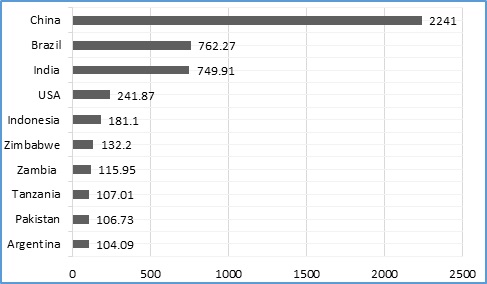
Tobacco was not grown in Pakistan at the time of independence, so in order to meet the country's tobacco demand, the government imported tobacco (Ali et al., 2015). In 1948, Pakistan departed from being fully dependent on tobacco imports and achieved self-sufficiency in tobacco production in 1969 (Majid et al., 2017). Before 1968, the cultivated tobacco in the country was not up to the standard; thus, the government spent valuable foreign exchange reserves to import high-quality raw tobacco to meet the industry's demands (Ali et al., 2015). The federal government of Pakistan started considerable measures to help develop and improve the country's tobacco sector in 1968. In order to achieve these goals, the Pakistan Tobacco Board (PTB) was established in 1968 to promote and increase tobacco production as well as tobacco exports from the country. Since its inception in 1968, the PTB has worked to defend the rights of tobacco producers, purchasers, tobacco product manufacturers, and tobacco processing dealers. The quality and quantity of tobacco match the world's leading tobacco-growing countries due to PTB research and development activities in the country (Ali et al., 2015).
As shown in table 1, the average level of production of raw tobacco was slightly higher than 100 thousand tonnes during the period 2000-01 to 2017-18. The highest output of raw tobacco in the country (129.8 thousand tonnes) was reported in 2013-14, followed by a decreasing trend in production up to 2017-18. Likewise, the production of raw tobacco in KP was the maximum in the same year 2013-14 (100.8 thousand tonnes), and there was a decreasing pattern up to 2018. The declining trend in production can be attributed in part to the shrinking cultivation area. In 2009-10, the KP's share of total production was the highest, accounting for 78.88 per cent of total raw tobacco produced in the country. Tobacco exports and their products are earning valuable foreign exchange for the government. In 2000-01, 3.21 million kilograms of raw tobacco (unmanufactured tobacco) were exported to various countries of the world, and in the same year, 84.19 million cigarette sticks and 3.86 million cigar sticks were also exported, earning 284.41 million rupees. Tobacco and its products were exported in 2017-18 for a total of $25.75 million. In 2017-18, Phillip Morris (Pak) was Pakistan's largest exporter of raw tobacco, while Pak Hills Company became the second-largest exporter of tobacco (Pakistan Tobacco Board, 2019).
Table 1. Share of Khyber Pakhtunkhwa in Cultivated Area and Tobacco Production in Pakistan
| Year width="133" colspan="2">Area Under Tobacco Cultivation,>(‘000’ Hectares) width="133" colspan="2">Production of Tobacco (‘000’ Tonnes) width="133" colspan="2">Yield in Kilograms>per Hectare width="71">Share of KP in total Production | > width="67"> Pakistan width="67">Pakhtunkhwa width="67">Pakistan width="67">Pakhtunkhwa width="67">Pakistan width="67">Pakhtunkhwa width="71">% | > 2000-01 width="67">45.6 width="67">26.5 width="67">85.1 width="67">61.2 width="67">1866 width="67">2309 width="71">71.91 | > 2001-02 width="67">49.4 width="67">29.8 width="67">94.5 width="67">69.9 width="67">1913 width="67">2346 width="71">73.97 | > 2002-03 width="67">46.6 width="67">27.2 width="67">88.2 width="67">64.3 width="67">1893 width="67">2364 width="71">72.90 | > 2003-04 width="67">45.6 width="67">27.0 width="67">86.2 width="67">62.9 width="67">1890 width="67">2330 width="71">72.97 | > 2004-05 width="67">50.5 width="67">32.2 width="67">100.5 width="67">77.3 width="67">1990 width="67">2401 width="71">76.91 | > 2005-06 width="67">56.4 width="67">36.5 width="67">112.6 width="67">87.9 width="67">1996 width="67">2408 width="71">78.06 | > 2006-07 width="67">50.9 width="67">30.8 width="67">103.3 width="67">78.2 width="67">2029 width="67">2539 width="71">75.70 | > 2007-08 width="67">51.4 width="67">32.7 width="67">107.8 width="67">84.9 width="67">2097 |